Showing posts with label scott prize. Show all posts

Monday, March 24, 2014

Dan Powell Tells Us About Writing & Place

I'm delighted to welcome Dan Powell to the blog today - he has just given birth to his first book, the short story collection Looking Out Of Broken Windows, published by Salt, who shortlisted the book for their Scott Prize - and you can win yourself a copy, more on that below. Congratulations, Dan. It is an enormously fine collection, for which I provided him with the following quote:

‘Short stories are portholes allowing us to peek – and, with great stories, step – into other worlds. Dan Powell’s broken windows are not themselves flawed or malfunctioning, rather doorways into the fraught and fractured lives of others. Powell’s mischievous imagination takes him wherever he pleases and where it lands he weaves story so tightly, so compellingly that you are held. Not constrained by the real, Powell uses surreality and magic – a wheeling-dealing cancer, unborn twins scanning their parents-to-be, a self-starting fire – to illuminate truths with poignancy and humour, paying subtle homage to the short story masters who inspired him, from Kafka to O’Connor and Carver.’

Dan is here today to give us a peek into his writing life by answering my writing&place questionnaire. First, here's a little about Dan:

Dan Powell is a prize winning author whose short fiction has appeared in the pages of Carve, Paraxis, Fleeting and The Best British Short Stories 2012. His debut collection of short fiction, Looking Out Of Broken Windows, was shortlisted for the Scott Prize in 2013 and is published by Salt. He procrastinates at danpowellfiction.com and on Twitter as @danpowfiction.

Dan is giving away a signed copy of Looking Out of Broken Windows to one reader of the blog tour; he will post to anywhere in the world. To win just leave a comment on this post or any of the other LOoBW blog tour posts appearing across the internet during March 2014. The names of all commenters will be put in the hat for the draw which will take place on April 6th.

At the end of this blog post is a fabulous and unique video trailer of Dan reading an excerpt from one of his stories! Before we get to that, here's what Dan had to say on writing & place:


Tania: Where are you? 

Dan: I live in an old farmhouse in the midst of the Lincolnshire countryside. The nearest market town is Horncastle, the antiques capital of Lincolnshire. The stories in Jon McGregor's short fiction collection, This Isn’t The Sort of Thing That Happens to Someone Like You, are all set in Lincolnshire, with one even set in Horncastle itself. I bought and read the collection just after we moved here. A great way to experience the stories, surrounded by the places that inspired them. Our village is really just a street and a small, disused church, surrounded by pastureland. It's a wonderfully quiet part of the world, perfect for writing.

I am very lucky to have a study in this new house, it’s only a box room, just big enough for a desk and a few book shelves, but it is wonderful to finally have a room in which I can shut myself away to write. It even has a window overlooking the surrounding fields and in the summer evenings I sit there watching the house martins that nest in the eaves darting back and forth outside.

There are loads of great countryside walks we can take just by stepping outside our front door, so when the weather’s good, we make the most of it and get out and about. We also have a massive garden here, which feels even bigger with the views of the surrounding fields. Great for the kids. Lots of space to play in. In the summer heritage aircraft fly overhead, and throughout the year we get the odd fighter jet from the RAF bases scattered around the county, all of which my boys love, obviously.

T: How long have you been there? 

D: We moved here last August, when we returned from spending seven years or so living in Germany. It was only on coming back that my wife and I realised quite how much we had missed being in the UK. Simple things like browsing English bookshops and being able to buy good old fashioned Fish and Chips still feel like a real treat. We had put off coming back for a year or two and now I wish we had come back sooner.


T: What do you write? 

D: Up until now I have mostly written short fiction. My stories tend to move between gritty realism and magical realism with most of my latest work landing somewhere in between, bridging the gap between these often opposing approaches to story telling. A fair few people have commented on how my writing seems to pull off what they thought of as two conflicting and incompatible styles of writing in the same piece. My debut collection, Looking Out of Broken Windows, is made up of the best of my last five years or so of short story writing and I am already knee deep into a follow-up collection, with about seven or eight stories done.

I am also writing a novel as part of my MA Creative Writing studies. The deadline is this coming September and I am currently on target to finish. Writing the novel has been a massive challenge and a very different writing experience to writing short stories. I have enjoyed the challenge of the novel but I my heart belongs to short fiction.

T: How do you think where you are affects what you write about and how you write? 

D: Places which resonate with me tend to end up in my writing but often long after I have left there. In 2008 and 2009 we spent some excellent holidays in Highcliffe, on the south coast of England. The coastline there is striking, half of it landscaped the other half scarred by cliff-slips and eroded shores. This setting features in a few of my stories; Third Party, Fire & Theft in the collection is set in part in the public car park outside The Cliffhanger cafe their, while Rip Rap, recently shortlisted for the Willesden Herald Short Story Prize, is set in a fictitious version of one of the holiday camps set along the eroding cliff faces that stretch of to the east. More recently we spent a few holidays visiting various parts of Denmark and it’s wide skies and lengthy coastlines struck a chord with me. The notes I made in our holidays there are just starting to find their way into becoming stories.

That said, moving to Lincolnshire has had a real impact on my writing though, and it is the first place I have lived in that I have consciously tried to write about. The landscape moves between the sweeping hills of the Wolds and the broad flat farmland of the south of the county. The last few months I have been working on completing a draft of my novel, the final third of which now features a section set in a Lincolnshire village not unlike the one I am living in. I feel like I am starting to really understand how setting can be an integral part of my fiction. It is starting to move more to the fore of what I write. Looking back at the stories in the collection I can see this process actually began a while back with stories like Third Party, Fire and Theft and Storm in a Teacup. I’m looking forward to exploring more of the local area and hope it continues to inspire me.


Thank you, Dan, we hope so too! And talking of Storm In A Teacup, Dan has kindly made this teaser for us, listen to him read an excerpt:


Don't forget to leave a comment here for a chance to win a copy of the excellent Looking Out Of Broken Windows, which you can read more about, as well as about Dan himself, at www.danpowellfiction.com.

Monday, May 09, 2011

Congratulations are in order!

There's nothing greater than being able to congratulate my smart and talented friends, and there's a lot today! First, the wonderful Lauri Kubuitsile is shortlisted for the highly prestigious Caine Prize for African Writing for her short story “In the spirit of McPhineas Lata” from The Bed Book of Short Stories published by Modjaji Books! Winner announced in July, fingers crossed, Lauri!

Second - huge congratulations to Andrea Ashworth and Jon Pinnock who, along with Cassandra Parkin, are the three winners of this year's Salt Publishing Scott Prize for debut short story collections. Their collections will be published in November, the UK's National Short Story Week. Can't wait to read them!

Addendum: Third lot of congratulations, to Tom Vowler, whose collection, The Method, has been shortlisted for the Edge Hill Short Story Prize, alongside collections from Helen Simpson, Polly Samson,Graham Mort and Michele Roberts. Winner announced in July. Read my interview with Tom here.

Thursday, February 24, 2011

Tom Vowler Talks

Well, my writing shed is nearly ready so I ask you to suspend disbelief and picture me and my guest today, Tom Vowler, sitting in there, sipping tea (or G&T... or beer) and chatting. Can you picture it? Here's what Tom looks like, if it helps (even though there is sea behind him, please disregard the ocean).


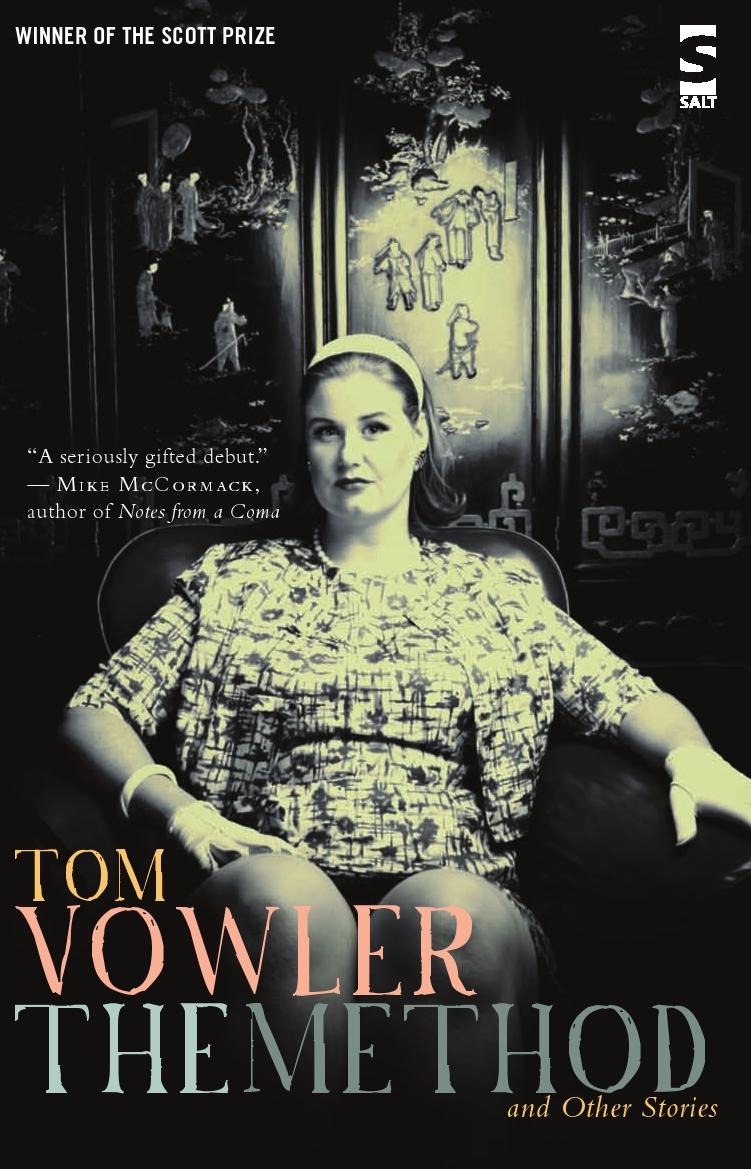
Tom is the author of the excellent and Scott-prize-winning collection The Method and Other Stories, published by Salt in 2010, and the forthcoming novel, All that Binds Us, which is a dark psychological thriller set on Dartmoor. On the subject of locations, I thought I'd first ask Tom the questions I've asked all those who've taken part in my Writing & Place series. And then we have a chat about his short story collections.Enjoy!

Tania: Where are you?

Tom: A stannary town on the edge of Dartmoor, in south-west England.


Tania: How long have you been there?

Tom: Just over a year, having been a decade in Plymouth.


Tania: What do you write?

Tom: Literary fiction, I suppose, though my agent has just described my novel as a psychological thriller. Short stories too.


Tania: How do you think where you are affects what you write about and how you write?

Tom: I actually moved here in order to finish my novel, which is set in the uplands of the moor. Visiting once a week didn't allow me to immerse myself fully in the landscape, which, for me, is one of the main 'characters' of the book. Research became a delight, learning about Dartmoor's history, its people, the flora and fauna. Watching the changing seasons, writing scenes where they occur, has given me a profound affection for the region, one I hope has permeated my fiction. Scenes in the moor's pubs were meticulously researched. :)


Tania: Yes, Tom, I have no doubt about that! Ok, onto The Method and Other Stories. Having just re-read the title story, it made me think of a question for you. I recently commented on a friend's blog post about the old chestnut, "writing what you know" and I said Well, while I believe in making things up, it's hard to write what you don't know, and perhaps writing and knowing are actually unconnected. What's your take, given that you the main character in your story goes to the most extreme lengths to get to know the main character in his novel...and you have actually moved house in order to better research yours?

"My own approach to research had never been this committed; if I wanted to write about something, I’d read about it. I’d Google the hell out of it and then use my imagination to make notes and diagrams, charts with lines linking characters, the complex worlds they occupied, their beliefs, histories, idiosyncrasies, what I thought they ate, how they voted. I’d construct their lives, give them voices, breathe life into them. I thought that was enough. But then, at a meeting with my publisher, the issue of authenticity arose." (From The Method)"


Tom:  I had some fun with that story, although it’s worrying how many people think it’s autobiographical in some way. It’s largely tongue-in-cheek, but does throw up questions on research and its thoroughness. The inspiration came from reading about the extent an actor had gone to for a part in search of authenticity, something we as writers also strive for.

Writing what you know is well and good, but would soon make for stolid fiction; you’ll quickly run out of subject matter, emotional experiences, anecdotes. And so we must venture into unfamiliar worlds, whether literally or vicariously, in order to assimilate the themes and people we’re writing about. Annie Proulx is a good example, someone who totally immerses herself in a community during composition, giving her a sense of dialect, of customs, the minutiae of a culture.

And, yes, moving house to be near the setting of my novel was a big commitment, but meant I could actually write scenes where they took place, or an hour after visiting them. The alternative was to go there only fortnightly and read about the place in between, which is always going to give you a second-hand account. I now have a profound love for the wilderness I’ve spent two years writing (among) and about.

But research isn’t always so edifying. The same book involved studying the darker aspects of human behaviour and I was glad not to do this first-hand.

Tania: I just noticed, rereading the excellent Seeing Anyone, the scientific imagery, "the earth's curvature", "like a distant star", "the Doppler effect", "a shape hidden within an optical illusion" . Does this reflect what you were reading at the time? Tell us more!

Tom: Good question – the scientist in you coming out! There was nothing overtly contrived in this, but I do have a wholly amateur curiosity in astronomy and physics (until their enormity and scope overwhelm me), and it’s likely some influence occurred there. On a conscious level, I suppose we search for the language, the imagery, to best describe a feeling or behaviour, and this works best for me if the simile or metaphor is somehow juxtaposed with its partner. And so with this rather elegiac story (and indeed with Staring at the Sun), I used aspects of the physical, scientific world to flank the most abstract, metaphysical of matters: love.


Thank you so much, Tom. You finish your tea (or G&T... or beer) while I tell the folks, whose appetites have surely been whetted, that they can purchase your book directly from Salt, or from Amazon or the excellent Book Depository and read the recent review by Melissa Lee-Houghton on The Short Review.  That's all for today, dusk is falling over the shed. Pictures soon, I promise!

Friday, January 08, 2010

Scott Prize shortlist - congrats to all!

Salt has just announced the shortlist of the inaugural Scott Prize for Short Fiction, which they call
"an important new venture for Salt as we continue to discover and nurture new talent from around the English-speaking world. The prize forms part of Salt’s commitment to the short story, to debut collections and to our vision of new literature in English as an international endeavour."
Congrats to the 12 full-length collections shortlisted - and especially to my friends and writing colleagues Susannah, Joel and Tom! - from almost a hundred entries and a longlist of 25. 4 winning titles will be announced next month for publication in the summer.

1. Ben Cheetham: The Hate Club (UK)
2. Alexandra Fox: Roundabouts (UK)
3. Miriam Hastings: Demon Lovers (UK)
4. Patrick Holland: The Source of Sound (Australia)
5. Sandra Jensen: A Sort of Walking Miracle (Ireland)
6. Laurence Klavan: Family Unit and Other Fantasies (US)
7. Wes Lee: This Animal Kingdom and Other Stories (NZ)
8. Mary McClusky: Gift to the Dark Gods (UK)
9. David Philip Mullins: Longing to Love You (US)
10. Susannah Rickards: Hot Kitchen Snow and Other Stories (UK)
11. Tom Vowler: They May Not Mean To But They Do (UK)
12. Joel Willians: Buy Ma Biscuits or Kiss Ma Fish (UK)

May this be the start of a wonderful year of short story success for all these writers!