Showing posts with label virtual book tour. Show all posts

Thursday, July 10, 2014

That Dark Remembered Day


I am delighted to welcome Tom Vowler back to the blog today, to talk about his brand new novel - his third book - That Dark Remembered Day. Tom was here last year talking about his first novel, What Lies Within, and two years before that to chat about his short story collection, The Method. He's not been sitting still much! Below, we play Word Association, with Tom answering in the voice of his main character. But first...


 Alison Moore, author of The Lighthouse, called That Dark Remembered Day "a compelling story about damage done, a touching exploration of the possibility of forgiveness and recovery" and Anthony McGowan, author of Mortal Coil, said: "Almost every page has the sort of perfect sentence or paragraph that makes you want to elbow the stranger next to you on the train, point with a stubby finger, and say: ‘Read that. Just read it.'"

Here's a quick synopsis: 

A son returns to where he grew up, where his mother still lives and where a terrible event in his childhood changed the lives of every person living there. As the story unfolds through the eyes of the son, the mother and finally the father, the reader experiences the taut build up to one day's tragic unravelling, and the shock waves that echoed through a once happy family and close-knit community. Will they ever be able to exorcise the damage of that day or do some wounds run too deep?

Tom is giving away a copy to one lucky blog reader - just leave a comment below! Here's a little bit about Tom: " Tom Vowler is a novelist and short story writer living in south west England. His debut collection, The Method, won the Scott Prize in 2010, and his novel What Lies Within received critical acclaim. He is co-editor of the literary journal Short Fiction and an associate lecturer in creative writing at Plymouth University, where he’s completing a PhD looking at the role of the editor in fiction. That Dark Remembered Day is his second novel. More at www.tomvowler.co.uk"

To whet your appetite further, here are me and Tom playing Word Association, with Tom answering as Stephen from That Dark Remembered Day:

HOME


Sanctuary by the sea.


FRIEND

Betrayed in childhood. Forgiveness sought.


BIOLOGY


Work, the sea, escape.


MOTHER


Eccentric, avoided.


VICTIM


Thirteen.


WAR


Father remained there.


FAMILY

Broken forever. New one found.


MEMORY

Buried. Unwelcome.


STORY

Cover. Truth hidden.


DEATH

Seen.


LOVE


Daughter. Wife. Hope.


Intrigued? You should be! To find about more about Tom's amazing novel, visit his website. Don't forget - to be in with a chance of winning a copy, leave a comment below. Thanks for playing, Tom!


Monday, March 24, 2014

Dan Powell Tells Us About Writing & Place

I'm delighted to welcome Dan Powell to the blog today - he has just given birth to his first book, the short story collection Looking Out Of Broken Windows, published by Salt, who shortlisted the book for their Scott Prize - and you can win yourself a copy, more on that below. Congratulations, Dan. It is an enormously fine collection, for which I provided him with the following quote:

‘Short stories are portholes allowing us to peek – and, with great stories, step – into other worlds. Dan Powell’s broken windows are not themselves flawed or malfunctioning, rather doorways into the fraught and fractured lives of others. Powell’s mischievous imagination takes him wherever he pleases and where it lands he weaves story so tightly, so compellingly that you are held. Not constrained by the real, Powell uses surreality and magic – a wheeling-dealing cancer, unborn twins scanning their parents-to-be, a self-starting fire – to illuminate truths with poignancy and humour, paying subtle homage to the short story masters who inspired him, from Kafka to O’Connor and Carver.’

Dan is here today to give us a peek into his writing life by answering my writing&place questionnaire. First, here's a little about Dan:

Dan Powell is a prize winning author whose short fiction has appeared in the pages of Carve, Paraxis, Fleeting and The Best British Short Stories 2012. His debut collection of short fiction, Looking Out Of Broken Windows, was shortlisted for the Scott Prize in 2013 and is published by Salt. He procrastinates at danpowellfiction.com and on Twitter as @danpowfiction.

Dan is giving away a signed copy of Looking Out of Broken Windows to one reader of the blog tour; he will post to anywhere in the world. To win just leave a comment on this post or any of the other LOoBW blog tour posts appearing across the internet during March 2014. The names of all commenters will be put in the hat for the draw which will take place on April 6th.

At the end of this blog post is a fabulous and unique video trailer of Dan reading an excerpt from one of his stories! Before we get to that, here's what Dan had to say on writing & place:


Tania: Where are you? 

Dan: I live in an old farmhouse in the midst of the Lincolnshire countryside. The nearest market town is Horncastle, the antiques capital of Lincolnshire. The stories in Jon McGregor's short fiction collection, This Isn’t The Sort of Thing That Happens to Someone Like You, are all set in Lincolnshire, with one even set in Horncastle itself. I bought and read the collection just after we moved here. A great way to experience the stories, surrounded by the places that inspired them. Our village is really just a street and a small, disused church, surrounded by pastureland. It's a wonderfully quiet part of the world, perfect for writing.

I am very lucky to have a study in this new house, it’s only a box room, just big enough for a desk and a few book shelves, but it is wonderful to finally have a room in which I can shut myself away to write. It even has a window overlooking the surrounding fields and in the summer evenings I sit there watching the house martins that nest in the eaves darting back and forth outside.

There are loads of great countryside walks we can take just by stepping outside our front door, so when the weather’s good, we make the most of it and get out and about. We also have a massive garden here, which feels even bigger with the views of the surrounding fields. Great for the kids. Lots of space to play in. In the summer heritage aircraft fly overhead, and throughout the year we get the odd fighter jet from the RAF bases scattered around the county, all of which my boys love, obviously.

T: How long have you been there? 

D: We moved here last August, when we returned from spending seven years or so living in Germany. It was only on coming back that my wife and I realised quite how much we had missed being in the UK. Simple things like browsing English bookshops and being able to buy good old fashioned Fish and Chips still feel like a real treat. We had put off coming back for a year or two and now I wish we had come back sooner.


T: What do you write? 

D: Up until now I have mostly written short fiction. My stories tend to move between gritty realism and magical realism with most of my latest work landing somewhere in between, bridging the gap between these often opposing approaches to story telling. A fair few people have commented on how my writing seems to pull off what they thought of as two conflicting and incompatible styles of writing in the same piece. My debut collection, Looking Out of Broken Windows, is made up of the best of my last five years or so of short story writing and I am already knee deep into a follow-up collection, with about seven or eight stories done.

I am also writing a novel as part of my MA Creative Writing studies. The deadline is this coming September and I am currently on target to finish. Writing the novel has been a massive challenge and a very different writing experience to writing short stories. I have enjoyed the challenge of the novel but I my heart belongs to short fiction.

T: How do you think where you are affects what you write about and how you write? 

D: Places which resonate with me tend to end up in my writing but often long after I have left there. In 2008 and 2009 we spent some excellent holidays in Highcliffe, on the south coast of England. The coastline there is striking, half of it landscaped the other half scarred by cliff-slips and eroded shores. This setting features in a few of my stories; Third Party, Fire & Theft in the collection is set in part in the public car park outside The Cliffhanger cafe their, while Rip Rap, recently shortlisted for the Willesden Herald Short Story Prize, is set in a fictitious version of one of the holiday camps set along the eroding cliff faces that stretch of to the east. More recently we spent a few holidays visiting various parts of Denmark and it’s wide skies and lengthy coastlines struck a chord with me. The notes I made in our holidays there are just starting to find their way into becoming stories.

That said, moving to Lincolnshire has had a real impact on my writing though, and it is the first place I have lived in that I have consciously tried to write about. The landscape moves between the sweeping hills of the Wolds and the broad flat farmland of the south of the county. The last few months I have been working on completing a draft of my novel, the final third of which now features a section set in a Lincolnshire village not unlike the one I am living in. I feel like I am starting to really understand how setting can be an integral part of my fiction. It is starting to move more to the fore of what I write. Looking back at the stories in the collection I can see this process actually began a while back with stories like Third Party, Fire and Theft and Storm in a Teacup. I’m looking forward to exploring more of the local area and hope it continues to inspire me.


Thank you, Dan, we hope so too! And talking of Storm In A Teacup, Dan has kindly made this teaser for us, listen to him read an excerpt:


Don't forget to leave a comment here for a chance to win a copy of the excellent Looking Out Of Broken Windows, which you can read more about, as well as about Dan himself, at www.danpowellfiction.com.

Monday, June 03, 2013

What Lies Beneath What Lies Within

I am delighted to welcome Tom Vowler back to the blog today. Tom is another of my immensely talented writer mates, and he was here a few years ago when his first book, the short story collection The Method, was published (Salt), talking about writing & place. Tom's second book, What Lies Within, a novel, was recently published by Headline, an enormously intriguing and powerful book, a very moving meditation on family, trauma and pain, with a very interesting structure. Here is a little about Tom:

Tom Vowler’s debut short story collection, The Method, won the international Scott Prize in 2010 and the Edge Hill Readers’ Award in 2011. Now an associate lecturer at Plymouth University, his debut novel What Lies Within was published in April 2013. Tom is also Assistant Editor for the literary journal Short FICTION. In 2008 he graduated with an MA in Creative Writing and is now studying for a PhD, looking at landscape and trauma in fiction. More at www.tomvowler.co.uk

Here is the wonderful book trailer for What Lies Within:


I decided to chat to Tom about something I've been thinking about for a while: where do we writers get permission from in our writing? I blogged about this here. Tom gave us some insight into his writing and his novel in particular:

Tania: So, I'd like to carry on the discussion I was having on my blog about permissions - who or what has given or gives you permission in your writing, and especially to do what you've done in the novel, which has such an interesting structure? Other writers, teachers, other people's books/stories/poems, other art forms? 

Tom: Hi Tania. Thank you for having me at your aesthetically gorgeous blog. Your question is a wonderfully refreshing one, worthy of pause and consideration. Focusing on my novel, the concept of permission is, as you’ve discussed below, related to a sense of risk, and in my case this resides particularly in the decision to narrate almost all the book from a female perspective. Firstly, there was the question of whether I could pull this off, capture fully the nuance of voice and behaviour across 300 pages. But also, as you’ve reminded me, I thought long and hard about the right (permission if you like) to do so. Of course as writers we frequently inhabit characters who are wildly disparate to ourselves; why should a switch in gender be any different? I suppose because I needed Anna (the main character of What Lies Within) to carry the heft of the entire book, its themes and motifs, the pace and narrative all had to emerge from her, including several aspects of life my own gender preclude me from. Fortunately I have several good female friends who were happy to share the vagaries of their lives, from seismic happenings such as childbirth to the more mundane aspects. And yet it was Anna’s inner world, understanding her reaction to the beautiful and terrifying things that happen to her that proved hardest.

As for permission, this was a question I had already resolved before the first draft. Most of my fiction emerges from a single event, often a piece of news that both appals and fascinates me. This becomes the book’s fulcrum, the driving force for its story and characters. And so without offering spoilers, once I’d found my subject matter (or it me), I had little choice. Hardly permission, but then I realised the fact I’d found great abhorrence with Anna’s terrible situation and its subsequent contrails, left me feeling I would tell her story with sympathy and respect. Likewise during the research for the novel, hearing the terrible things some women had to endure instilled in me a fierce desire to get it right, to respect not just my characters and readers, but these wonderfully brave women also.

 As for permission to write in its wider context, my hand was forced a little by a long illness that saw me unable to do little else. I worked as a journalist, and although my love affair with books was late to blossom, I soon realised the dark art of storytelling was for me. Permission at that time was more closely aligned with inspiration, and I was desperate to mimic the impact certain fiction was having on me in my own work. So whereas richly lyrical prose, compelling characters and concept-driven stories were important to me, I quickly became interested in the tone and texture of the novel, one of the main reasons I set the book on the uplands of Dartmoor. In this sense the brooding, menacing landscape became a character itself, alive and capricious, the reader investing every much in the tors and valleys of the place as the people of the book. As you mention, the novel’s structure carries its own risk as well, but it too was driven by my research and the need to tell Anna’s story fully and with compassion. But then it’s one of the first things I tell my students – to take risks. Learn from what’s gone before, understand why it works, but do it differently. To borrow some words for a change: risk nothing, risk everything.

 As for other writers who give me permission to take such risks, I think this occurs, for me anyway, on a subconscious level, or at least a level that sits just below the surface during composition. I love much of what Julian Barnes and Sebastian Faulks have done in this regard - especially the deployment of unreliable narrators in their recent work - but with such impressive oeuvres behind them, I imagine it feels less like risk-taking to them. Two books that have had an astonishing impact on me recently for their linguistic and emotive brilliance are Sarah Hall's short story collection The Beautiful Indifference and J.A. Baker's memoir The Peregrine, the latter hugely influential on the novel I'm currently writing. Permission here, I find, is bestowed on an emotional level by the feelings aroused in me when reading them. This is not restricted to books, though; my own sense of aesthetics comes as much from film (for example the work of Mexican director Iñárritu) as it does from the literary forms.
 

Thank you so much, Tom, I find all that you've talked about to be really fascinating additions to this ongoing discussion about permission and risk. And the "risks" you took most definitely paid off here! I highly recommend you all get your hands on both What Lies Within and The Method, both of which you can find more about on Tom's website. But wait! Tom has very kindly offered a free copy of What Lies Within to one of you, my lovely blog readers. So, if you'd like to win a copy, leave a comment and tell me and Tom what's given you permission - in any way at all - recently, and that way we can extend this discussion and Tom will pick someone out of the proverbial hat. Thank you for stopping by, Tom!

Friday, August 17, 2012

The Englishman by Helena Halme

Very interesting discussions still ongoing in the comments section of my previous post, and I am going to do a post summing up what we were talking about, but in the meantime I want to introduce you to Helena Halme and her debut novel, The Englishman. I've known Helena since we both did the MA in Creative Writing at Bath Spa University in 2003, and am so thrilled to be talking about her new book here today. Isn't it a gorgeous cover?

The Englishman is subtitled "Can love go the distance" and it is quite the page-turner, I've had difficulty stopping myself from devouring it. It is the story of Kaisa, a young Finnish girl who meets and falls in love with Peter, an English naval officer. As the blurb says:
"At the age of twenty, Kaisa has her life mapped out. After university in Helsinki, she’s going to marry her well-to-do fiancé, Matti, and live happily ever after. But in October 1980, she's invited to a British Embassy cocktail party, and meets a dashing Naval officer. In the chilly Esplanade Park the Englishman and Kaisa share passionate, secret kisses and promise to meet up again. But they live thousands of miles apart – and Kaisa is engaged to be married.

At the height of the Cold War the Englishman chases Russian submarines whilst Kaisa’s stuck in a country friendly with the Soviet Union. Will their love go the distance?"
Helena, who lives in England and is married to an Englishman, has made no secret of the fact that this novel has its roots in autobiography - in fact, it started life as a series of blog posts called How I Came to Be In England. But what she has done here so well is to completely fictionalize the story and provide all the required tension that keeps you reading and reading. All the small details about Finland and Sweden give the book such colour, and I love seeing England through Kaisa's eyes!

Helena and her book seem to lend themselves well (who doesn't?) to my writing & place questionnaire, so I asked her a few questions:

Where are you?
Helena

I live in Crouch End, North London.

How long have you been there?

I was born in Finland and moved to the UK some 25 years ago. Because my husband served in the navy, we move about a lot, finally settling down to Wiltshire where we lived for 15 years in a very rural setting. Some two years ago we decided we’d had enough of country life, upped sticks and moved to the city. And haven’t looked back.

What do you write?

Helsinki
I write fiction, mainly novels set in Finland and Sweden, where, as a child, I lived for a short while. My stories vary from romance (The Englishman) to family sagas (Pappa’s Girl, out in September), to spy thrillers (The Red King of Helsinki out in October). I also write a blog, Helena’s London Life, about my new surroundings.

How do you think where you and where you've been affects what you write about and how you write?

The Real Englishman: Helena's husband David
My origins have everything to do with what I write. I love describing life in Finland or Sweden in my books, as I think most people want a story to take them somewhere, not just emotionally but also geographically.

My latest novel, The Englishman, is set in Finland in the 1980’s and was inspired by my own story of how I met my husband and moved to the UK. It’s my third novel, but the one which is most closely based on my own life.

Sicily
But I am also hugely affected by my immediate surroundings. A few years ago, when we rented a villa in Sicily, I began a novel after watching a group of local boys dive into the sea from high rocks. Seeing them hurtle down time and time again, not looking where they were jumping, made me fear that they’d hurt themselves. I recalled how my husband had told to me many years previously about a young sailor jumping to his death on a day out by the coast of somewhere. In the story which I started (but haven’t yet finished) a boy plunges to his death from a rock. This story keeps haunting me, so I am sure one day a scene like this will turn up in one of my novels.

Thanks so much Helena, it's going to be a busy year with two more books coming out! You can buy The Englishman  as an ebook on Amazon (current price 0.77p!) or Smashwords ($0.99), find out more about the book  on Facebook and its blog and follow Helena on Twitter to keep up to date with this and her other books.  Good luck with it all, Helena, I am off to find out what happens with Kaisa and Peter....!

Thursday, August 02, 2012

Tony Hogan Pops By

I first met Kerry Hudson through her blog, Kerry's Window, a few years ago now, I think, bonding through short stories, of course! I am absolutely and utterly thrilled to now be welcoming her here to chat about her brand new and debut novel, the excellent-titled (she even beats my book for title length) Tony Hogan Bought Me An Ice Cream Float Before He Stole My Ma. It is a fantastically-voiced, evocative, dark and yet hopeful story of Janie, who talks to us from the moment of her birth, and whom we follow as her mother drags her from one less-than-salubrious Scottish council flat to another, with a succession of highly unsuitable boyfriends, including the eponymous Tony H.

Place and location are very strong in the book, and Kerry herself grew up "in a succession of council estates, caravans and B&Bs", so I decided to ask Kerry my Writing & Place questionnaire:

Tania: Where are you? 

The Turkish wedding dress shop
Kerry: I'm at my window looking over all of Hackney. I live above a Turkish wedding dress shop (yes, those are the dresses) on the top floor and can see all the way across Hackney to the BT Tower.


T: How long have you been there? 

K: Four years in total, broken by six months in Vietnam. So two years were spent up towards the Stoke Newington end which is very liberal and environmentally oriented (lots of yoga mats and organic food) and then the last two years down the Dalston end which is hipster central (think warehouse parties, 90's fashion and Red Stripe). For all that, there's an incredibly diverse community here: Caribbean, African, Turkish, Orthodox Jewish, Kurdish, Hungarian, Cockneys and a fairly big gay community and for the most part we all get along great. I feel so at home here, I truly love it.

T:  What do you write? 

Novels. I write short stories too but I find them far more difficult. I do poetry only when it is someone's birthday and I know they won't mind my rhyming 'cat' with 'mat' in their card. I'm about to start a short screenplay and want to adapt Tony Hogan into a stage play too. Oh, and lists. I am a list obsessive.

T: How do you think where you and where you've been affects what you write about and how you write? 

The view from Kerry's window
Because Tony Hogan... is based on my own upbringing I would say sense of place is hugely important to how I write (and to the book as sense of place is a significant thing Janie and her family lack). Every estate, council flat and B&B that Janie Ryan lived in, I lived in too and I couldn't have written what I did without those places.

Likewise, my second novel, Thirst, is set between my current neighbourhood and Siberia and I travelled across the length of Russia to make sure the Siberia sections were as honest and realistic as possible. Funnily enough, I've travelled fairly extensively elsewhere. I've never written anything exploring those travels but I like to think that one day it'll be time to write my Vietnamese/Parisian/American novel.

Thank you so much, Kerry - good luck with the screenplay and the adaptation into a stage play, I've tried those and they're really fun! To find out more about Kerry, visit her website and I highly recommend you get your hands on her book!

Monday, July 30, 2012

Mother America touches down...


I am delighted to be hosting  Nuala Ní Chonchúir's second appearance on my blog in 12 months - for the second book of hers that has been published in that time! You may remember she was last here in December talking about The Juno Charm, her glorious fourth poetry collection. And now here she is again with her glorious fourth short story collection, Mother America (New Island) - and there is her novel,You, published in 2010.

A little about Nuala: She is a short story writer, novelist and poet, born in Dublin in 1970 and living in Galway. A story from this new collection, Peach, was published in the Winter 2011 issue of Prairie Schooner, and won the Jane Geske Award and was nominated for a Pushcart Prize.

This is a fabulous collection, which combines so many images, themes and Nuala's trademark beautiful use of language. It contains one of my favourite stories of last year, the Dublin Review of Books flash-fiction-contest winner, The Egg Pyramid. Read it. It's unforgettable.

For her stop here, I didn't want to ask Nuala questions I've asked before so I thought we'd play Word Association. I threw words at her that I drew from her stories and she responded to each without planning or thinking too hard. Read her responses below - and do feel free to play it yourself with the same words and share your responses in the comments section! Take it away, Nuala!


Art 
The beautiful art that fills my home by people as diverse as my father and my old friend, Pat Jourdan. Art makes me happy.

Mother 
A mother is what I have been for nearly 19 years, so almost half of my life. I think it’s a difficult job but has its good bits too. Also the word mother is one half of the title of my new book so I am extraordinarily fond of the word at the moment. 

Blue 
Oooh, one of my favourite colours. I collect blue and white pottery and glass. I love blue for its deep, mesmeric qualities. 
Home 
Dublin. I live in Galway, but Dublin is home. 
Science 
Knickers. That was my science teacher’s nickname. Bless her, she may have been brilliant but I learnt nothing. 
Feminism 
A subject dear to my heart. For me it’s all positive – I love a good feminist, man or woman. 
America 
A country I have fallen in love with, despite its flaws. I love American people’s positivity and can-do-ness. I have had fabulous times in New York, Los Angeles, Nebraska, Arkansas, Chicago. And I’m going back next year for more. 
Family 
This word makes me think of my wider family who mostly live in Dublin and whom I miss being around. They are good fun – we laugh a lot when we get together. 
Story 
One of my favourite things on earth is the short story, as reader and writer. To read a sublime collection, like Sarah Hall’s recent The Beautiful Indifference, makes me feel good about the world and about writing. Hall’s language; the tension in the stories – just wonderful. 
Money 
I hate money but would like lots of it. I am convinced I would make an excellent rich person. 
Love 
Being in love is the best thing ever. And giving and having my kids’ love blows my mind sometimes. I am surrounded by love these days and it is fantastic.


Thank you, Nuala, what a beautiful note to end on. Find out more about all Nuala's writings and activities at http://nualanichonchuir.com/, buy Mother America  - and if you didn't read The Egg Pyramid then read it now.

Thursday, July 26, 2012

Quickies

Just a quick note to say that I am over at Women Rule Writer today, where Nuala has made me answer the author questionnaire I'd been getting authors to fill in for The Short Review but never thought I'd answer myself  - about My Mother Was An Upright Piano! And, if you want even more of me waffling on, Joe M at Bristol Short Story Prize has kindly published the speech I made at the awards ceremony at ShortStoryVille on July 14th - my "while stocks last" speech! I've never really given a speech before, but was happy I managed to get a little physics in there too (but no Higgs boson, sorry). Also, the program has now been announced for the fab Cork International Short Story Festival so make your plans, book your train/plane/ferry, you don't want to miss this. And do come join me in the four-day flash fiction workshop I'm running, or one of the other fantastic workshops, including the above-mentioned Nuala -  we're going to have fun!

And don't forget to check out my previous blog post with upcoming deadlines, places to send your short stories and flash fictions.

Wednesday, July 18, 2012

Possessed!

I first heard of Niki Valentine when I read her excellent novel The Killing Jar (published as Nicola Monaghan) which I found utterly gripping, a dark story of drugs and family. So it's with great delight that I welcome Niki here to the blog in honour of the imminent publication of her new book, Possessed (published by Sphere), which sounds just as gripping! (My copy is on its way to me, I can't wait. How beautiful is that cover?). Here's the blurb:
Emma's life has always been a struggle, and now she's been accepted at a prestigious music school, she is determined to excel. But when the impossibly chic twins, confident Sophie and quieter Matilde, come crashing into her life - surrounding her with champagne and parties - they demand Emma's full attention. Then shy Matilde commits suicide and shockingly, her identical twin Sophie flourishes. Now odd things are happening to Emma: blackouts, waking up in strange places, bizarre dreams. Something, or someone, is consuming Emma's mind. Terrified, Emma begins to doubt everything and everyone around her, especially the beautiful Sophie... Powerful, twisted, atmospheric and disturbing, Possessed is a terrifying psychological thriller. 
Possessed is published as an ebook on July 25th and as a paperback on Oct 25th.

I thought I'd get nosey and ask Niki, who, as well as writing, teaches creative and professional writing at Nottingham University, my set of writing&place questions, which seem simple but I always find them very revealing! Welcome, Niki!


Tania: Where are you?

Niki: I’m in Aspley, Nottingham, just a couple of miles from where I was born, and streets away from where I spent much of my childhood, and where my first novel is set.

T: How long have you been there?

N: I’ve been living in Aspley again since last December, when my husband and I bought our first house. I lived on the other side of Nottingham before that, but was here again when my first novel came out, and when I got married. I’ve spent more time here than anywhere else in the world, despite all my travels. It’s a very working class area, with council and ex-council houses, and it feels like home when I walk the streets. I’ve been back in Nottingham, after wandering far and wide, since 2002, so ten years now. I came back to study at Nottingham Trent University, on their MA Creative Writing.

T: What do you write?

Niki and Allan Silitoe at the Broadway in Nottingham
N: I write gritty, realist literary fiction but also, more recently, psychological thrillers with a supernatural element. My last novel was a modern take on the ghost story set in the Highlands of Scotland and the new one, as the title might suggest, explores the idea of spiritual possession. I like stories about the paranormal that feel real, and where you can find alternative, psychological explanations for what’s happening to the characters.

T: How do you think where you and where you've been affects what you write about and how you write? 

Niki at the Empire State Building, New York City
N: Because I’d lived all over the world, for a long time I wrote about the big, glamorous cities I’d lived in, such as Paris and Chicago. When I came back to Nottingham, though, I realised how interesting my home city is and wrote a novel set here. Now, I tend to focus on ordinary characters in extraordinary situations, instead of the big cities. Being in Nottingham, especially close to the estate I grew up on, reminds me of being little. The world felt different then; more magical, perhaps, full of possibilities. Full of shadows too, and darkness. Walking these streets takes me right back there when I’m in the right mood.

More specifically, though, The Haunted was inspired by my honeymoon. Considering that it’s about a failing marriage, that might seem a bit ironic, but there’s the fiction in it. We travelled to the highlands and walked in the hills. We ended up walking through the dark one day, when we set out too late, and I was really struck by how quiet it was, and how lonely, and how frightening it could have been had I been with someone I didn’t trust. There are so many rumours about haunted bothies too, and I can understand why. The dark and the damp and the rugged landscape evokes the ghosts, I think.
 
Niki in her garden
I work at the University of Nottingham and, walking around its older campus, I’m often thrown back to what it felt like to be a student, away from home for the first time. Then I think about York University, where I lived for four years, and how young and naïve I was back then. I settled to it so easily but I was one of very few people from my kind of working class background. That got me to thinking about how the University experience could feel, especially if you were shy, and pushed into an environment where there was a lot of pressure. I love music, and taught myself to play the piano when I was younger, so all of that fed into my planning for Possessed. It’s not based on any of the Universities I know well but, in a way, inspired by all of those I’ve visited.


Thank you so much, Niki, it's really interesting to hear how you were inspired by your hometown after coming back from your world travels. Lovely to hear that you are enjoying living where you grew up, this is something that fascinates me, I can't really imagine it, I always think if I did, there would be too many ghosts of my childhood!

This makes me even more eager to read Possessed. You can pre-order it now from the Book Depository or Amazon (ebook & paperback). and do visit Niki's website for more about her books. Thanks for stopping by, Niki!

Sunday, April 15, 2012

Weird Things Customers Say in Bookshops

This was going to be a fairly ordinary interview as part of a virtual book tour for an author I "only" know from Twitter, but then, on Tues night, I popped in to meet Jen Campbell at her event at the fantastic Edinburgh Bookshop (which I could easily live in) ...and, well, after only planning to stay, umm, 20 minutes, I left three hours later, after 2 glasses of prosecco and much merriment! And... with some lovely photos of the author herself (taken with the Hipstmatic app on my iPhone so they're very "artistic"):


So what is this all about? Well, I don't often laugh out loud while reading a book. It is rare indeed. But Jen Campbell's fantastic Weird Things Customers Say in Bookshops, published a few weeks ago by Constable, had me chuckling, giggling, and interrupting J's reading to make him listen! It is exactly as it says, a collection of some of the weirdest things said to Jen and to other booksellers in bookshops. This is clearly a very good idea for a book - Jen's been interviewed on Radio 4's Open Book program and got lovely mentions in the Guardian and the Daily Telegraph newspapers here in the UK.

I am delighted to have Jen here today: she is a writer and bookseller living in London, a published poet and short story writer. Weird Things is her first book; her poetry collection The Hungry Ghost Festival will be published later this year by The Rialto. She blogs at This Is Not The Six Word Novel. Before getting to my interview with Jen, here's a little taster from the book, which you will have your chance to win:
customer: Doesn’t it bother you, being surrounded by books all day? I think I’d be paranoid they were all going to jump off the shelves and kill me. 
bookseller: . . .

Tania: Your book made me seriously question the sanity of many members of the public. It might almost been seen as a philosophical tract about sense versus nonsense, or a scientific work about the bizarre workings of the human brain. Did you feel you learned anything about the human condition from all these interactions?

Jen: Being able to share these moments, first on my blog, and now as a longer collection in book form is, I guess, my open 'WTF?' question to the world. The fact that the blog posts made their way quickly across Twitter, and made people giggle, validated my own sanity, which I found myself questioning at times when the oddest things that were said to me. You know, doing a double take and inwardly saying to myself: "There is no map of Atlantis... I definitely don't have a book that forecasts the weather for the rest of the year... no, books are not edible... nor do they conduct electricity... and, no, this is not Hampstead Heath; this is a bookshop."
    As to whether it helped me understand the human condition... no, probably not, but perhaps I'm now more prepared ;)
   [Also, I must point out that I would never, ever include quotes from anyone who was actually mentally unstable. These quotes are just rude/odd/bizarre things said by people who should know better.]

customer: I do find it odd that people manage to make a living out of writing books for children. I’m sure any mother could do it. 
bookseller: Why don’t you try it yourself? 
customer: I always mean to, but I’m very busy right now with my pottery class.

T: It's really funny to read - but how did all this make you feel at the time? Especially as a writer yourself, what did you learn from these interactions as to how people interact with books and the book trade?

J: Some of it made me blink and do a double take. Some quotes are funny, and were at the time. There were rude things said to me, which aren't included in the book [my decision] but were included in the blog posts which definitely were not funny. However, the quotes that reoccur quite frequently - price-checking on iphones; people calling up the bookshp for advice on books and then saying they'll go and buy the book on Amazon; one person who thought that all independents were owned by Waterstone's - these definitely show that, for some, there is a lack of understanding when it comes to the book trade.
   A lot of people forget how many people have to be paid for the production of just one book [editors, writer, illustrator, designers, production, marketing, an agent, wholesaler, and then the bookshops who have to pay rent, staff, business rates etc], and think that £7.99 for a paperback is too much. It's not a massive sum; it's less than the price of a cinema ticket or a take-away, and a book can change your life. Sounds corny, but it's true. I love a good curry as much as the next person, but one tikka masala's probably not going to change my outlook on life.
   Also, the big one: "It must be lovely working in a bookshop; you get to read all day." *sigh* I wish I had a penny for every time this was said to me.

T: I loved your section at the end with quotes from other booksellers, do you think there's something about a bookshop that leads to this kind of craziness? How do you try and explain it?

J: I think anyone who has worked in retail has weird stories to tell. Bookshops in particular - especially antiquarian ones - seem to attract odd requests. Perhaps because, in the case of the latter, the books are old, read long ago and we associate memories with them that perhaps don't make sense to us, so when we try and describe a book to someone else it comes out sounding a little odd. But that only accounts for 1% of the strange requests and those are understandable - what's not is when someone might say they read a book and it was blue, and they were three, and truly expect you to know which book they mean. Sometimes I can find these books, and those are amazing moments, but normally with a little bit more to go on than just one colour.
   I don't think I can try and explain the international nature of Weird Things... - I've no idea. But at least it makes us giggle.

bookseller: Can I help at all? 
customer: Yes, where’s your fiction section? 
bookseller: It starts over on the far wall. Are you looking for anything in particular? 
customer: Yes, any books by Stefan Browning. 
bookseller: I’m not familiar with him, what kind of books has he written? 
customer: I don’t know if he’s written any. You see, my name’s Stefan Browning, and I always like to go into
bookshops to see if anyone with my name has written a book.
 
bookseller: . . . right. 
customer: Because then I can buy it, you see, and carry it around with me and tell everyone that I’ve had a novel published.Then everyone will think I’m really cool, don’t you think? 
bookseller: . . .

T: As an antidote, what was the most intelligent question or comment you received in a bookshop?
J: I don't know about intelligent [there's obviously lots of those, though], but the lovely comments are always nice. I'd say about 80% of the people who walk into Ripping Yarns bookshop [the antiquarian bookshop where I work] say: "Oh, the smell of books is amazing!". Then there are our loyal customers who want to support our bookshops and keep us running which is just fantastic; parents who bring their children along at weekends to read and show them their own favourite books from when they were young. I had a child in last week who looked around the shop with his mouth open, turned to his dad and said: "Bookshops are special places, aren't they, dad?" That sounds pretty intelligent to me.

Thank you, Jen! Jen has extremely generously given me a copy of her book to giveaway to one lucky blog reader! So, here's the challenge: What's the weirdest thing you could imagine someone might say to a bookseller? The most creative answer wins the book! Just put your answer in a comment on the post, you have a week, til April 23rd, and then Jen and I will pick a winner! 

Jen is appearing at Blackwell's bookshop in Oxford this Tues night, April 17th, at 7pm, so if you're in the area, pop by, say hi and buy a book! Find out more on her blog.

Thursday, March 29, 2012

Vanessa Gebbie Drops By To Celebrate Her Paperback

 I am more than delighted to have my great friend, writing colleague and sometime partner-in-crime (come flash with us!) Vanessa Gebbie: writer, teacher, author of two short story collections (Words From A Glass Bubble, Storm Warning) and editor of the fantastic Short Circuit: A Guide to the Art of the Short Story. She's popping in today in honour of the publication of the paperback of her stunning novel, The Coward's Tale. Here's  little about the book:


The boy Laddy Merridew, sent to live with his grandmother, stumbles off the bus into a small Welsh mining community, where he begins an unlikely friendship with Ianto Passchendaele Jenkins, the town beggar-storyteller. Ianto is watchman over the legacy of the collapse many years ago of Kindly Light Pit, a disaster whose echoes reverberate down the generations of the town.

As I said on my Amazon review, "... I finished The Coward's Tale this afternoon and I think it astonishing... It is a poem, it is stories, it is a novel, it's a song, it is about death, life, family, tragedy, history. It is about the power of story and the telling of stories and what that does for the individual, for the community, for those who have experience great loss and are trying to rebuild and move forward. For me it had echoes of the Holocaust. And the way it all came together was immensely powerful..."

So, enough of all the superlatives, let's hear from Vanessa! This book is very much rooted in place, and so I asked her the questions I ask all those who are part of my Writing & Place series here on the blog:

Tania: Where are you? 

Vanessa: I am sitting up in bed in my bedroom at home, in a small group of similar houses in a village called Ringmer, in East Sussex. I have somehow managed to live in the south east of England all my married life - it is not where I would choose to live, if there were no constraints - but my husband’s work was here - a family dental practice. The bedroom has just been painted, and everything smells of new paint. The walls and cupboards are cream - it’s a bit like sitting inside a gigantic meringue. I am here becaue I’ve managed to get a fluey thing. Pathetic, huh? 

T: How long have you been there?

Sitting in bed, all day. 
In this house, thirteen years. 
In the south east of England thirty-six years, if not a bit more. That is, we’ve been wed thirty six years - before that I lived in London for a while, working for the Ministry of Defence, in the mid seventies. Then I commuted to town from Brighton. It was a good thing the railway line started and stopped at the stations I used - I slept most of the time. I remember one bloke went to sleep on the last train after a Christmas party, and woke up in a siding. He had no idea where he was and stayed on the train until someone came the next day. 

T: What do you write?

V: My writing has always been other than the realities of how and where I live. It is just an extension of how I was as a child - dreaming, imagining, escaping. Why escape to the house next door with people who mirror the neighbours? How boring is that? No disrespect to my neighbours, who are great - its just what goes on in my head is far more interesting to me than what goes on outside the window. I am not drawn to write about people whose lives are comfortable, thank you very much - as mine has been. There are no stories there. 

Merthyr Tydfil
The only way I have used my own life is in exploring the issues of displacement, otherness, adoption, abandonment, and this I did in many short stories. And latterly, in recreating the streets of Merthyr Tydfil in south Wales, whilst writing The Coward’s Tale. My memories of staying every holidays with my grandmother in Twynyrodyn came back so clearly - a real help in creating the places in the novel. Merthyr was not a wealthy community back then, and it is less so, now. My grandparents were fairly typical - one grandfather was a miner then a steelworker, and the other worked on the railway. They both died within a few days of each other, far too early. Life was hard. 
WWI tank

My father and mother were both born just after the First World War - my father recalled seeing the soldiers parading up the High Street when the war ended. He was four. He remembered playing as a boy on an old tank that had been used as a war fundraiser, in Thomastown Park. And he remembered nicking coal from across the valley with his father, and piling it into his toddler brother’s pram to wheel home in the dark. 

I was brought up on stories like that. My mother walking three miles to school, three miles back - jumping the ash bins as she went. My grandfather giving my grandmother a bracelet the day after their wedding day, a bracelet he’d saved up for for months, hiding it under a slice of toast on a tray he carried up to their bedroom. I’ve got that bracelet - I’m keeping it for my grand-daughter. I have always felt much closer to the place that bore those stories, than the relatively comfy places I live. Is that a bad thing? Tough. I went to a talk by George Steiner at The Royal Society of Literature a few years ago. “I don’t want to read any more novels about divorce in Hampshire”, he said. Neither do I - not that I have read many, must admit. I don’t want to write them, either. I defend the right of any writer to write what they want! And the right of any reader to read what they want, too

T: How do you think where you are and where you've been affects what you write about and how you write?

V: Hmm. Now, I like places that are not hugely populated, which are remote. Quiet corners of Wales, the West Country, Ireland, Scotland. Some of the best places I have been to - Antarctica, South Georgia, Spitzbergen, Iceland - are empty in large parts. I would go back to those places tomorrow - and you’d find it hard to persuade me to visit teeming cities for any length of time. I like to hear myself think. 

Plymouth colliery
You really can’t get much more different to the bustle of the south east. Perhaps that attraction - (which has always been there) has crystallised into the need to get away to write. To get away to a place where I can be quiet for days, weeks at a time, lost in my own imaginings. Where I do not have to dredge up polite conversation, make endless compromises, or have to decide that I can afford to spend only three hours writing before doing the ‘real’ jobs that make the world go round, allegedly. 

I am an unfriendly beast, really. And as I am happier ‘on the edge of things’, looking back in, so I am drawn to write about characters who are also on the edge of things. I want to know why - but I understand them, at base. Maybe when you are given away as a baby, you are consigned to the edges no matter how happy your adoption is. I don’t mind in the least - its far more interesting there, looking in from the outside. 

Plymouth colliery
In The Coward’s Tale, there are several outsiders - old Ianto Jenkins, the beggar, ‘The Coward’ of the title, who was ostracised once, but who has now earned a place to perch in the community, as storyteller. And there’s Ieuan (Laddy) Merridew, an awkward little boy who is sent to the town to stay with his gran while his warring parents sort out a broken marriage, and who strikes up a real friendship with Ianto. Possibly the first friendship either has experienced. It is no coincidence that they are the main characters, or that I identify with them both, or indeed, that I feel I know these two the least. 

***
Well, I'd like to state that I am an "unfriendly beast" too, that's probably what all us writers need to be otherwise we'd be socializing too much to write! Thank you, Vanessa,  for this insight both into the book and your life, and for the fabulous images.

I urge you all to get hold of a copy of  The Coward's Tale (link goes to the Book Depository, with free worldwide delivery), which is published by Bloomsbury, and find out more about Vanessa's writings and activities on her blog. Amazingly she is defying the laws of physics today (or perhaps becoming a quantum particle) by being in three places at once - catch her over at Claire King's blog and Sara Crowley's blog - and tomorrow she is further afield! Thanks for coming, V.

Sunday, March 04, 2012

An Interview with Tim Jones in Which Men are Briefly Explained

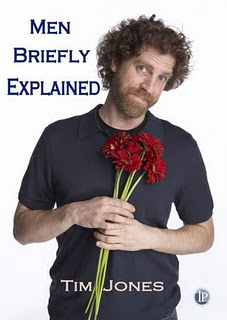
Yes, it's all-poets and all-virtual-book-tours round here at the moment! I "met" Tim Jones when we reviewed his excellent short story collection, Transported, on The Short Review, and we e-bonded over our shared disdain for genre labels. A bit like my previous interviewee, Sarah Salway, he writes in many forms - novels, short stories and poetry, and he's here today to chat about his new poetry collection, the wonderfully-titled Men Briefly Explained.

He kindly agreed to answer my Writing&Place questionnaire (illustrated with gorgeous photos, and some great Lord-Of-The-Rings-related information) and then I tacked on a question I was particularly interested in... and then he has allowed me to reprint one of the poems. I loved the book - hard to choose just one!

TH: Where are you?
TJ: I live in Wellington, New Zealand, in the suburb of Mt Victoria, on the slopes of one of Wellington's many steep hills, Tangi Te Keo aka Mt Victoria. I measure my location by how long it takes to walk to places: 
  •  fifteen minutes to where I work - I have a part-time job in the IT industry, as my writing doesn't quite pay those annoying bills that tend to pile up 
  • ten minutes to the edge of the restaurant district, which transforms into the "drunk teens" district on Friday and Saturday nights 
  • five minutes to the Basin Reserve, Wellington's international cricket ground and one of my favourite places. It was earmarked for a shipping basin until the 1855 earthquake raised it high enough to become a cricket ground instead 
  • maybe 90 seconds to the nearest "Lord of the Rings" filming location 
The floor of the quarry at the top of Ellice St, Mt Victoria, Wellington. In The Fellowship of the Ring, this view is briefly shown when the hobbits look down from Weathertop at the approaching Ringwraiths. Sadly, the cage full of gas pipes was left on the cutting-room floor.

TH: How long have you been there? 

TJ: The short answer is that I've lived in Wellington, and in this house, since 1993. The longer answer is that I was born in Cleethorpes, Lincolnshire in 1959. My family emigrated to New Zealand when I was 2 years old, on an assisted passage - we were what used to be known here as "ten-pound Poms", a term also used in Australia, which proved to be a lucky break for me last year.
The back wall of the quarry above Ellice St, Mt Victoria, Wellington. It may not look like much now, but in The Return of the King, this is where Aragorn, Legolas, and Gimli enter the Paths of the Dead. Don't try to follow them, as you would bump your nose on the rocks.

I grew up in New Zealand's southernmost province, Southland, went to Otago University in Dunedin, and moved to Wellington when I got together with Kay, to whom I've now been married for coming up on 18 years. All these places have left their mark on my poetry, most of all Southland.

What do you write? 

I write more types of work than is good for me: poetry, short stories, and novels. I've had three poetry collections, two short story collections, and one novel published, and I've also co-edited an anthology of New Zealand science fiction poetry, Voyagers: Science Fiction Poetry from New Zealand, with Mark Pirie.

 
Just to make my "brand identity" even more diffuse, I write both speculative fiction (mainly science fiction, but with occasional excursions into fantasy and horror) and literary fiction. Well - literary fiction is a loaded term, so let's say "fiction that isn't speculative fiction". My one published novel is a fantasy novel.

How do you think where you are affects what you write about and how you write? 

I think that the experience of being an immigrant, and the places I've lived since we moved to New Zealand, have had a strong influence on my writing, and that it's affected my fiction and my poetry somewhat differently.

I'm not always aware of this at the time of writing, but looking back at my fiction, I see that a surprising number of my stories are about journeys and voyages, successful or otherwise - it's why I titled my second short story collection Transported - and, especially in my early stories, they are often about figures isolated in a hostile landscape.

Looking from the quarry down Ellice St, Mt Victoria, Wellington, where I live. In the middle distance is the Basin Reserve cricket ground, where I first beheld Arwen Undómiel - well, Liv Tyler anyway. She was watching the cricket with her boyfriend and Théoden (Bernard Hill).


Some of my poems are based on what I observe of other people and the world around me, and some on flights of imagination (intergalactic and otherwise), but much of my poetry is based in personal experience, and a lot of those take place outside somewhere: on beaches, in forests. Although I've written poems about Wellington and Dunedin, a lot of these poems return to my childhood in Southland.
Looking from the top of the Ellice St quarry, where several scenes of Peter Jackson's Lord of the Rings trilogy were filmed, across the Te Aro district of Wellington, with Victoria University and the hill suburb of Kelburn in the distance.

My father used to work as a fisheries inspector, with a beat that took him right across the southern coastline of New Zealand from east to west. There is some wild country down there, and even wilder seas, and those trips with my Dad are particularly treasured memories, as poems like "Men at Sea" show. The first part of that poem is about a trip my Dad took without me, and the second is about the ferry crossing to Rakiura (Stewart Island), off the south coast of Southland, on which I often accompanied him:

Men at sea, I take my father's hand
as we approach the village, houses
hunched against the glowing skies. 

Of course, these poems are also about my relationship with my father.

TH: You write poetry, novels, short stories - how is the process of writing each unique? I'm starting to write poetry and finding that for the first time I can write about myself, which I can never do in fiction. Do you find this?

TJ: I tend to work on one at a time, with occasional recidivism - at the moment, I'm "meant" to be working on short fiction, but my last writing session was mainly spent on writing poetry instead.

Poems and short short stories are different from the others in that I can complete the first draft of a poem or a short-short story in a writing sessions (if all is going well, I can draft several poems in a session). From that perspective, writing a novel is like writing a long short story - both have to be spread over multiple sessions, but the number of sessions for a novel is rather large!

I have written one published and one unpublished novel. At the moment, due to other commitments - my need to bring in enough income to the household, and also environmental campaigns I'm involved in - I don't envisage starting another novel for at least a couple of years, but I am squirrelling ideas for novels away.

Beyond that, when I get an idea or look back at my ideas lists, I usually have a sense of whether this is a "poem idea" or a "short story idea", or proceed accordingly. A couple of times, I have used the same idea in both a poem and a short story, but that's unusual.

Both my fiction and my poetry are a mixture of work based closely on personal experience, work based on observation, and works of imagination (though usually with some observation and personal experience mixed in). I've noticed that it is the poems based on personal experience that tend to work best with a live audience. (Of course, the male character in the poem you've chosen to feature has nothing at all in common with me. Nothing at all!)


We believe you, Tim! Dear reader, you can make up your own mind, here is Tim's poem, Years With a Husband
Years with a Husband

Stone to her water
his edges eroded slowly
leaving the core in place.
He was immovable
from desk, chair,
or opinion,
the slave and exemplar
of routine.

If she let him
he would wear those clothes —
scuffed fawn trousers,
frayed blue shirt —
till eternity,
till kingdom come.
He would vote the same way,
express the same
dislikes:
lawn bowls, modern art, the very thought
of a Pacific holiday.
Their son
she now saw
was growing stony too.
She blamed testosterone
and private schools.

Still, there was this:
that as she stretched and changed
rode the courses of her life
her husband would always be there,
blunt, imperceptive, abrupt:
her rock.

Thank you so much, Tim, for such wonderful answers, pictures and poetry, it's been lovely having you! 

Here is Tim's full bio:

Tim Jones is a poet and author of both science fiction and literary fiction who was awarded the NZSA Janet Frame Memorial Award for Literature in 2010. Tim was born in Cleethorpes, Lincolnshire and his family emigrated to New Zealand when he was 2 years old. Tim now lives in Wellington, New Zealand. 

Tim's third poetry collection, Men Briefly Explained, was published in late 2011. Among his other recent books are fantasy novel Anarya’s Secret (RedBrick, 2007), short story collection Transported (Vintage, 2008), and poetry anthology Voyagers: Science Fiction Poetry from New Zealand (Interactive Press, 2009), co-edited with Mark Pirie. Voyagers won the “Best Collected Work” category in the 2010 Sir Julius Vogel Awards.  

For more, see Tim's blog: http://timjonesbooks.blogspot.com
You can also follow Tim on Twitter: http://twitter.com/timjonesbooks

 And info on how to buy the book - which I highly recommend - 


Details of how to buy Men Briefly Explained in print and various ebook formats are here: http://timjonesbooks.blogspot.co.nz/p/men-briefly-explained.html

For UK readers, Men Briefly Explained is available from Amazon.co.uk as follows:

Kindle ebook: http://www.amazon.co.uk/Men-Briefly-Explained-ebook/dp/B005HRYM32/

Paperback: http://www.amazon.co.uk/Men-Briefly-Explained-Tim-Jones/dp/1921869321/

Large print paperback: http://www.amazon.co.uk/Men-Briefly-Explained-1-Set/dp/1459627903/

 With all these fascinating guests, I'm inspired to go off and write... or at least try and save up to visit New Zealand! You can read the other Writing&Place interviews here.