Thursday, March 29, 2012

Vanessa Gebbie Drops By To Celebrate Her Paperback

 I am more than delighted to have my great friend, writing colleague and sometime partner-in-crime (come flash with us!) Vanessa Gebbie: writer, teacher, author of two short story collections (Words From A Glass Bubble, Storm Warning) and editor of the fantastic Short Circuit: A Guide to the Art of the Short Story. She's popping in today in honour of the publication of the paperback of her stunning novel, The Coward's Tale. Here's  little about the book:


The boy Laddy Merridew, sent to live with his grandmother, stumbles off the bus into a small Welsh mining community, where he begins an unlikely friendship with Ianto Passchendaele Jenkins, the town beggar-storyteller. Ianto is watchman over the legacy of the collapse many years ago of Kindly Light Pit, a disaster whose echoes reverberate down the generations of the town.

As I said on my Amazon review, "... I finished The Coward's Tale this afternoon and I think it astonishing... It is a poem, it is stories, it is a novel, it's a song, it is about death, life, family, tragedy, history. It is about the power of story and the telling of stories and what that does for the individual, for the community, for those who have experience great loss and are trying to rebuild and move forward. For me it had echoes of the Holocaust. And the way it all came together was immensely powerful..."

So, enough of all the superlatives, let's hear from Vanessa! This book is very much rooted in place, and so I asked her the questions I ask all those who are part of my Writing & Place series here on the blog:

Tania: Where are you? 

Vanessa: I am sitting up in bed in my bedroom at home, in a small group of similar houses in a village called Ringmer, in East Sussex. I have somehow managed to live in the south east of England all my married life - it is not where I would choose to live, if there were no constraints - but my husband’s work was here - a family dental practice. The bedroom has just been painted, and everything smells of new paint. The walls and cupboards are cream - it’s a bit like sitting inside a gigantic meringue. I am here becaue I’ve managed to get a fluey thing. Pathetic, huh? 

T: How long have you been there?

Sitting in bed, all day. 
In this house, thirteen years. 
In the south east of England thirty-six years, if not a bit more. That is, we’ve been wed thirty six years - before that I lived in London for a while, working for the Ministry of Defence, in the mid seventies. Then I commuted to town from Brighton. It was a good thing the railway line started and stopped at the stations I used - I slept most of the time. I remember one bloke went to sleep on the last train after a Christmas party, and woke up in a siding. He had no idea where he was and stayed on the train until someone came the next day. 

T: What do you write?

V: My writing has always been other than the realities of how and where I live. It is just an extension of how I was as a child - dreaming, imagining, escaping. Why escape to the house next door with people who mirror the neighbours? How boring is that? No disrespect to my neighbours, who are great - its just what goes on in my head is far more interesting to me than what goes on outside the window. I am not drawn to write about people whose lives are comfortable, thank you very much - as mine has been. There are no stories there. 

Merthyr Tydfil
The only way I have used my own life is in exploring the issues of displacement, otherness, adoption, abandonment, and this I did in many short stories. And latterly, in recreating the streets of Merthyr Tydfil in south Wales, whilst writing The Coward’s Tale. My memories of staying every holidays with my grandmother in Twynyrodyn came back so clearly - a real help in creating the places in the novel. Merthyr was not a wealthy community back then, and it is less so, now. My grandparents were fairly typical - one grandfather was a miner then a steelworker, and the other worked on the railway. They both died within a few days of each other, far too early. Life was hard. 
WWI tank

My father and mother were both born just after the First World War - my father recalled seeing the soldiers parading up the High Street when the war ended. He was four. He remembered playing as a boy on an old tank that had been used as a war fundraiser, in Thomastown Park. And he remembered nicking coal from across the valley with his father, and piling it into his toddler brother’s pram to wheel home in the dark. 

I was brought up on stories like that. My mother walking three miles to school, three miles back - jumping the ash bins as she went. My grandfather giving my grandmother a bracelet the day after their wedding day, a bracelet he’d saved up for for months, hiding it under a slice of toast on a tray he carried up to their bedroom. I’ve got that bracelet - I’m keeping it for my grand-daughter. I have always felt much closer to the place that bore those stories, than the relatively comfy places I live. Is that a bad thing? Tough. I went to a talk by George Steiner at The Royal Society of Literature a few years ago. “I don’t want to read any more novels about divorce in Hampshire”, he said. Neither do I - not that I have read many, must admit. I don’t want to write them, either. I defend the right of any writer to write what they want! And the right of any reader to read what they want, too

T: How do you think where you are and where you've been affects what you write about and how you write?

V: Hmm. Now, I like places that are not hugely populated, which are remote. Quiet corners of Wales, the West Country, Ireland, Scotland. Some of the best places I have been to - Antarctica, South Georgia, Spitzbergen, Iceland - are empty in large parts. I would go back to those places tomorrow - and you’d find it hard to persuade me to visit teeming cities for any length of time. I like to hear myself think. 

Plymouth colliery
You really can’t get much more different to the bustle of the south east. Perhaps that attraction - (which has always been there) has crystallised into the need to get away to write. To get away to a place where I can be quiet for days, weeks at a time, lost in my own imaginings. Where I do not have to dredge up polite conversation, make endless compromises, or have to decide that I can afford to spend only three hours writing before doing the ‘real’ jobs that make the world go round, allegedly. 

I am an unfriendly beast, really. And as I am happier ‘on the edge of things’, looking back in, so I am drawn to write about characters who are also on the edge of things. I want to know why - but I understand them, at base. Maybe when you are given away as a baby, you are consigned to the edges no matter how happy your adoption is. I don’t mind in the least - its far more interesting there, looking in from the outside. 

Plymouth colliery
In The Coward’s Tale, there are several outsiders - old Ianto Jenkins, the beggar, ‘The Coward’ of the title, who was ostracised once, but who has now earned a place to perch in the community, as storyteller. And there’s Ieuan (Laddy) Merridew, an awkward little boy who is sent to the town to stay with his gran while his warring parents sort out a broken marriage, and who strikes up a real friendship with Ianto. Possibly the first friendship either has experienced. It is no coincidence that they are the main characters, or that I identify with them both, or indeed, that I feel I know these two the least. 

***
Well, I'd like to state that I am an "unfriendly beast" too, that's probably what all us writers need to be otherwise we'd be socializing too much to write! Thank you, Vanessa,  for this insight both into the book and your life, and for the fabulous images.

I urge you all to get hold of a copy of  The Coward's Tale (link goes to the Book Depository, with free worldwide delivery), which is published by Bloomsbury, and find out more about Vanessa's writings and activities on her blog. Amazingly she is defying the laws of physics today (or perhaps becoming a quantum particle) by being in three places at once - catch her over at Claire King's blog and Sara Crowley's blog - and tomorrow she is further afield! Thanks for coming, V.

Tuesday, March 27, 2012

Poets v Proseurs, Not the Oxford Literary Festival

Sometimes I wonder how I get so lucky. I mean, look at this amazing line-up I am honoured to be part of at tomorrow night's Poets versus Proseurs event at the wonderful Not the Oxford Literary Festival!
Penny Goring, author of The Zoom Zoom
Joe A Briggs, Oxford’s voice of punk
Sarah-Clare Conlon, editor of Quickies
David Gaffney, author of The Half-Life of Songs
Calum Kerr, organiser of National Flash Fiction Day
Amy Riley, host of Brighton Fringe’s award-winning show Grit Lit
Fay Roberts, host of Poetry Kapow, Allographic & Hammer and Tongue Cambridge
Emily Harrison, winner of the 2010 Tower Poetry Prize
Lucy Ayrton, co-host of Hammer and Tongue Oxford
Tina Sederholm, co-host of Hammer and Tongue Oxford
Anna Percy from the Stirred poetry collective
Sian Rathore, editor at Metazen
Anna Hobson, author of Tales of Unrequited Love
Paul Askew, editor of Ferment Zine
James Purcell Webster, performance editor at Sabotage Reviews
Hannah Elwick, slammer and co-prankster behind Gin-Soaked Sheets
and the fabulous Dan Holloway will be MC!

I'm one of those wavering between prose and poetry - a kind of prosette, perhaps? -  I'm going to let the audience judge for themselves what it is I'm reading, mostly from my forthcoming collection, My Mother Was An Upright Piano: Fictions (published May 3rd, did I mention that??!).

Do come along if you're nearby! Entry is £2 all proceeds support The Albion Beatnik bookstore, which is where the event is, kicking off at 7pm. If you are on Facebook, more information here. Can't wait!


Sunday, March 18, 2012

More than Words

I had a brilliant time yesterday afternoon taking part in the Radio 4 More Than Words "listening festival" in Bristol! I was one of three local writers invited to create "short stories with sound" which we - me, Edson Burton and Paul Mundell (reading Tim X Atack's story) - then read, with sound effects provided by the amazing Radio 4 sound team, at the gorgeous St George's, in front of a live audience, and were recorded for broadcast.

It was a really interesting experience being asked to create words with sounds in mind. I ended up - as is my wont - not writing one 15-minute story by 3 very short stories, each one quite different but all in some way inspired by science (as is my wont), under the heading "Reality Check". I found that thinking about sound effects really added to the writing of the story - I could use the sounds as shorthand, make them really work hard, not just be gratuitous. I hope that what I wrote will work as "just" words on a page, but I really enjoyed having my senses stretched.


Reading them with the sound effects was also wonderful. I have to say, I do love being on stage, especially in such a glorious venue (see above) where we've been to hear a wide range of live music - and Margaret Atwood! Once you get me up there, under the lights, I don't actually want to get offstage. Two of my 3 stories were supposed to be funny, but you never really know until the reading, and the audience giggled in places I hadn't expected. For me, there's almost nothing better than making an audience laugh, I love it.

You'll be able to hear me reading the stories - and, I hope, some of the audience's giggles -  on Radio 4's (one remaining weekday) Afternoon Reading programme on Friday 13th April (auspicious??) and on iplayer for a week following that, I imagine. I will give you a link when it's available. I've had several stories on Radio 4 but this is the first time they've allowed me (nay, paid me) to read them myself, and it seemed to go down well so maybe they'll allow me to do it again! Thank you to our fantastic producer, Sara Davies, and to my fellow writers, Edson Burton (whose story, Hood,  will be broadcast the Friday after mine) and Tim X Atack, whose story Birdsong Man you can hear the week before mine.

Thursday, March 15, 2012

Get your entries in!!

Deadlines fast approaching for these two fantastic competitions:
 
The Bristol Short Story Prize - closes March 31st
One of the most prestigious short story comps around (yes, I am biased!) Stories up to 3000 words - can be much shorter (was won by a 300-word story a few years ago). Entry fee: £7. Prizes: £1000 + £150 Waterstones gift card/£700 + £100 Waterstones gift card/£400 + £100 Waterstones gift card. Winner and shortlisted published in the prize anthology. Enter here.


Short Fiction Short Story Competition - closes March 31st
Stories up to 5000 words. Entry fee: £10 for 2 stories and includes a copy of the next issue of the excellent SHORT Fiction lit mag. Prizes: £500 + publication, 2nd prize £100. Enter here.

Good luck to you all!

Wednesday, March 07, 2012

It's all flash!

Flash Fic News 1
So, I'm a little excited over here... I've just been asked to run not just one but a set of FOUR flash fiction workshops at one of my favourite festivals, the Cork International Short Story Festival in Cork, Ireland, in September. This is a festival you want to sell anything to make sure you can go to - it's heaven for short story writers, and not just the events but the after-parties where writers mingle with readers and listeners are a huge part of the attraction. So, come flash with me... or just come and be there! (Booking's not open yet, I believe, but soon...)


Flash Fic News 2

I'm delighted to have been commissioned, along with a fairly fabulous roster of flash writers, to write a new piece for the National Flash Fiction Day anthology - and the anthology wants your stories too. Here are the guidelines:
Submission Guidelines:

We are looking for flash-fictions of between 150 and 500 words (not including the title) from UK writers only.

They can be in any style or genre but we want you to use only a single word for the title and this word should be the prompt for the piece or indicative of the story's theme.

You may submit a maximum of two pieces.

Stories should be emailed as .doc, .docx or .rtf attachments. Please put your name, the title of the submission and your address (for proof of UK residence) into the body of the email.

Email your entries to nffdanthology AT gmail DOT com.

Stories should be previously un-published (except maybe on a blog for the purposes of workshopping) and no simultaneous submissions, please.

The deadline for submissions is 23.59 on Tuesday 10th April. Any submissions received after that time will not be considered.

If you are included in the anthology you will receive a free copy of the e-book edition plus a chance to buy a copy of the physical edition at a greatly reduced price.

Happy writing!

Sunday, March 04, 2012

An Interview with Tim Jones in Which Men are Briefly Explained

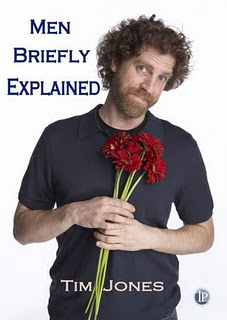
Yes, it's all-poets and all-virtual-book-tours round here at the moment! I "met" Tim Jones when we reviewed his excellent short story collection, Transported, on The Short Review, and we e-bonded over our shared disdain for genre labels. A bit like my previous interviewee, Sarah Salway, he writes in many forms - novels, short stories and poetry, and he's here today to chat about his new poetry collection, the wonderfully-titled Men Briefly Explained.

He kindly agreed to answer my Writing&Place questionnaire (illustrated with gorgeous photos, and some great Lord-Of-The-Rings-related information) and then I tacked on a question I was particularly interested in... and then he has allowed me to reprint one of the poems. I loved the book - hard to choose just one!

TH: Where are you?
TJ: I live in Wellington, New Zealand, in the suburb of Mt Victoria, on the slopes of one of Wellington's many steep hills, Tangi Te Keo aka Mt Victoria. I measure my location by how long it takes to walk to places: 
  •  fifteen minutes to where I work - I have a part-time job in the IT industry, as my writing doesn't quite pay those annoying bills that tend to pile up 
  • ten minutes to the edge of the restaurant district, which transforms into the "drunk teens" district on Friday and Saturday nights 
  • five minutes to the Basin Reserve, Wellington's international cricket ground and one of my favourite places. It was earmarked for a shipping basin until the 1855 earthquake raised it high enough to become a cricket ground instead 
  • maybe 90 seconds to the nearest "Lord of the Rings" filming location 
The floor of the quarry at the top of Ellice St, Mt Victoria, Wellington. In The Fellowship of the Ring, this view is briefly shown when the hobbits look down from Weathertop at the approaching Ringwraiths. Sadly, the cage full of gas pipes was left on the cutting-room floor.

TH: How long have you been there? 

TJ: The short answer is that I've lived in Wellington, and in this house, since 1993. The longer answer is that I was born in Cleethorpes, Lincolnshire in 1959. My family emigrated to New Zealand when I was 2 years old, on an assisted passage - we were what used to be known here as "ten-pound Poms", a term also used in Australia, which proved to be a lucky break for me last year.
The back wall of the quarry above Ellice St, Mt Victoria, Wellington. It may not look like much now, but in The Return of the King, this is where Aragorn, Legolas, and Gimli enter the Paths of the Dead. Don't try to follow them, as you would bump your nose on the rocks.

I grew up in New Zealand's southernmost province, Southland, went to Otago University in Dunedin, and moved to Wellington when I got together with Kay, to whom I've now been married for coming up on 18 years. All these places have left their mark on my poetry, most of all Southland.

What do you write? 

I write more types of work than is good for me: poetry, short stories, and novels. I've had three poetry collections, two short story collections, and one novel published, and I've also co-edited an anthology of New Zealand science fiction poetry, Voyagers: Science Fiction Poetry from New Zealand, with Mark Pirie.

 
Just to make my "brand identity" even more diffuse, I write both speculative fiction (mainly science fiction, but with occasional excursions into fantasy and horror) and literary fiction. Well - literary fiction is a loaded term, so let's say "fiction that isn't speculative fiction". My one published novel is a fantasy novel.

How do you think where you are affects what you write about and how you write? 

I think that the experience of being an immigrant, and the places I've lived since we moved to New Zealand, have had a strong influence on my writing, and that it's affected my fiction and my poetry somewhat differently.

I'm not always aware of this at the time of writing, but looking back at my fiction, I see that a surprising number of my stories are about journeys and voyages, successful or otherwise - it's why I titled my second short story collection Transported - and, especially in my early stories, they are often about figures isolated in a hostile landscape.

Looking from the quarry down Ellice St, Mt Victoria, Wellington, where I live. In the middle distance is the Basin Reserve cricket ground, where I first beheld Arwen Undómiel - well, Liv Tyler anyway. She was watching the cricket with her boyfriend and Théoden (Bernard Hill).


Some of my poems are based on what I observe of other people and the world around me, and some on flights of imagination (intergalactic and otherwise), but much of my poetry is based in personal experience, and a lot of those take place outside somewhere: on beaches, in forests. Although I've written poems about Wellington and Dunedin, a lot of these poems return to my childhood in Southland.
Looking from the top of the Ellice St quarry, where several scenes of Peter Jackson's Lord of the Rings trilogy were filmed, across the Te Aro district of Wellington, with Victoria University and the hill suburb of Kelburn in the distance.

My father used to work as a fisheries inspector, with a beat that took him right across the southern coastline of New Zealand from east to west. There is some wild country down there, and even wilder seas, and those trips with my Dad are particularly treasured memories, as poems like "Men at Sea" show. The first part of that poem is about a trip my Dad took without me, and the second is about the ferry crossing to Rakiura (Stewart Island), off the south coast of Southland, on which I often accompanied him:

Men at sea, I take my father's hand
as we approach the village, houses
hunched against the glowing skies. 

Of course, these poems are also about my relationship with my father.

TH: You write poetry, novels, short stories - how is the process of writing each unique? I'm starting to write poetry and finding that for the first time I can write about myself, which I can never do in fiction. Do you find this?

TJ: I tend to work on one at a time, with occasional recidivism - at the moment, I'm "meant" to be working on short fiction, but my last writing session was mainly spent on writing poetry instead.

Poems and short short stories are different from the others in that I can complete the first draft of a poem or a short-short story in a writing sessions (if all is going well, I can draft several poems in a session). From that perspective, writing a novel is like writing a long short story - both have to be spread over multiple sessions, but the number of sessions for a novel is rather large!

I have written one published and one unpublished novel. At the moment, due to other commitments - my need to bring in enough income to the household, and also environmental campaigns I'm involved in - I don't envisage starting another novel for at least a couple of years, but I am squirrelling ideas for novels away.

Beyond that, when I get an idea or look back at my ideas lists, I usually have a sense of whether this is a "poem idea" or a "short story idea", or proceed accordingly. A couple of times, I have used the same idea in both a poem and a short story, but that's unusual.

Both my fiction and my poetry are a mixture of work based closely on personal experience, work based on observation, and works of imagination (though usually with some observation and personal experience mixed in). I've noticed that it is the poems based on personal experience that tend to work best with a live audience. (Of course, the male character in the poem you've chosen to feature has nothing at all in common with me. Nothing at all!)


We believe you, Tim! Dear reader, you can make up your own mind, here is Tim's poem, Years With a Husband
Years with a Husband

Stone to her water
his edges eroded slowly
leaving the core in place.
He was immovable
from desk, chair,
or opinion,
the slave and exemplar
of routine.

If she let him
he would wear those clothes —
scuffed fawn trousers,
frayed blue shirt —
till eternity,
till kingdom come.
He would vote the same way,
express the same
dislikes:
lawn bowls, modern art, the very thought
of a Pacific holiday.
Their son
she now saw
was growing stony too.
She blamed testosterone
and private schools.

Still, there was this:
that as she stretched and changed
rode the courses of her life
her husband would always be there,
blunt, imperceptive, abrupt:
her rock.

Thank you so much, Tim, for such wonderful answers, pictures and poetry, it's been lovely having you! 

Here is Tim's full bio:

Tim Jones is a poet and author of both science fiction and literary fiction who was awarded the NZSA Janet Frame Memorial Award for Literature in 2010. Tim was born in Cleethorpes, Lincolnshire and his family emigrated to New Zealand when he was 2 years old. Tim now lives in Wellington, New Zealand. 

Tim's third poetry collection, Men Briefly Explained, was published in late 2011. Among his other recent books are fantasy novel Anarya’s Secret (RedBrick, 2007), short story collection Transported (Vintage, 2008), and poetry anthology Voyagers: Science Fiction Poetry from New Zealand (Interactive Press, 2009), co-edited with Mark Pirie. Voyagers won the “Best Collected Work” category in the 2010 Sir Julius Vogel Awards.  

For more, see Tim's blog: http://timjonesbooks.blogspot.com
You can also follow Tim on Twitter: http://twitter.com/timjonesbooks

 And info on how to buy the book - which I highly recommend - 


Details of how to buy Men Briefly Explained in print and various ebook formats are here: http://timjonesbooks.blogspot.co.nz/p/men-briefly-explained.html

For UK readers, Men Briefly Explained is available from Amazon.co.uk as follows:

Kindle ebook: http://www.amazon.co.uk/Men-Briefly-Explained-ebook/dp/B005HRYM32/

Paperback: http://www.amazon.co.uk/Men-Briefly-Explained-Tim-Jones/dp/1921869321/

Large print paperback: http://www.amazon.co.uk/Men-Briefly-Explained-1-Set/dp/1459627903/

 With all these fascinating guests, I'm inspired to go off and write... or at least try and save up to visit New Zealand! You can read the other Writing&Place interviews here.

Sunday, February 26, 2012

Sarah Salway Says You Don't Need Another Self-Help Book

Sarah Salway is a kind of Renaissance Woman: she does so many different things, and does them well - from writing novels and short stories to circus skills, garden history and climbing Mount Kilimanjaro - she's a true inspiration. I feel incredibly lucky not just to be her friend but to have co-tutored an Arvon Foundation short story course with her last year - I have no doubt I learnt as much from her as our students did. And she kept me sane with regular infusions of chocolate, and the odd drop of whisky...

Here's her official bio: 

Sarah Salway is Canterbury Laureate and Royal Literature Fund Fellow at the London School of Economics. You Do Not Need Another Self-Help Book is her first poetry collection, and she is the author of three novels (Something Beginning With, Tell Me Everything and Getting the Picture) and a collection of short stories, Leading the Dance. Her poems have won significant prizes in competitions organised by Poetry London, the Essex Poetry Festival and The New Writer, and have appeared in publications including the Financial Times, The Virago Book of the Joy of Shopping, Mslexia, Pen International and Poetry London. Sarah is the Chair of the Kent & Sussex Poetry Society.

So, this brings me to my joy at hosting Sarah here today to showcase her new book - her first collection of poetry, You Don't Need Another Self Help Book, published by Pindrop Press. Isn't the cover stunning?

Sarah is doing an audio blog tour - the first time I've hosted anything like this, and today she is reading us an excellent poem I heard her read live (at the same reading where I, with great terror, read out my first poem!)  called Love and Stationery. Listen and enjoy...


It's no wonder Philip Gross called her collection
[s]ubtly angled glimpses of love, sex, marriage, which reveal them as they really are: matters of life and death. There's a quiet sizzling underneath the surface of these poems, which can make you smile and wince at the same time.

You may not need another self-help book but you do need this one. Buy it here. You know you want to... You can find out more about Sarah on SarahSalway.net, and listen to her read another poem over at Danuta Kean's website. What fun!

Sunday, February 19, 2012

Sunday Times EFG Private Bank short story award longlist

The longlist for the £30,000 Sunday Times EFG Private Bank short story award has been announced - 10 women, 10 men, ranging in age from 31 to 94, apparently! Congratulations to all - especially my friend Alison MacLeod!

Diana Athill - 'A Hopeless Case'
Kevin Barry - 'Beer Trip to Llandudno'
Evgenia Citkowitz - 'Business Class'
Will Cohu - 'Two Bad Thumbs'
Emma Donoghue - 'The Hunt'
Jackie Kay - 'These Are Not My Clothes'
A L Kennedy - 'Late in Life'
Jean Kwok - 'Where the Gods Fly'
Barrie de Lara - 'Dinner at Benutti's'
Tom Lee - 'The Current'
Toby Litt - 'The Sandy'
Alison MacLeod - 'The Heart of Denis Noble'
Martin Malone - 'Valley of the Peacock Angel'
Robert Minhinnick - 'El Aziz: Some Pages From His Notebooks'
Linda Oatman High - 'Nickel Mines Hardware'
Alison Pimlott - 'Five Year Diary'
Tamara Pollock - 'Elsa'
Alex Preston - 'The Bridge Over Shuto Expressway No. 1'
Lionel Shriver - 'Prepositions'
Johanna Skibsrud - 'Fat Man and Little Boy'

It's wonderful to see Big Names rubbing shoulders with names I don't recognise, I'm eager to find out more about the stories... how about an anthology of all 20 longlisted stories, Sunday Times & EFG?


Wednesday, February 15, 2012

New story and some upcoming deadlines

I have a new story, The Tragedy of Tragic Men, (which was a finalist in PANK's 1001 Awesome Words Competition) published today in the February issue of the excellent PANK magazine, which just got a fabulous mention in the New York Times Style magazine's feature on literary magazines, one of the intello-chic, apparently! 

I am planning a blog post talking about the wonderful-so-far experience of working with my new publishers, Tangent Books, a small press based here in Bristol, on my new collection, but not quite ready yet - we're still choosing fonts and the illustrator is working on some ideas! (Wow, so exciting to be involved in the whole process!)

In the meantime, here are some upcoming deadlines for you...

BBC International Short Story Competition - closes Feb 27th

Open to international entrants for the first time this year, in honour of the London Olympics! Story: 8000 wds max. Prize: £15,000/£2500/8x£250. Rules: Strictly one entry per person. Open only to writers who have been previously published by an established UK publisher or an established UK magazine (no self-publishing or online publishing) Email entries allowed but must be accompanied by entry form from website. If posting entry you must send 8 copies of your work. No entry fee. Enter here.

The Binnacle Ultra Short Competition - closes March 15th

"We are looking for prose and poetry: all works should be 150 words or fewer; poetry should be sixteen lines or fewer and fewer; all works should have a narrative element." All submissions should be made via email to ummbinnacle@maine.edu. No entry fee, a minimum of $300 in cash prizes awarded. And all the finalists are published in a beautiful publication! Enter here.


Fish Flash Fiction Prize - closes March 20th

"This is an opportunity to attempt what is one of the most difficult and rewarding tasks - to create, in a tiny fragment, a completely resolved and compelling story in 300 words or less." 1st prize 1000 euros and publication in winners anthology. 9 runners-up. Entry fee 14.00 euros for first entry, 8 euros for each subsequent entry.  Enter here.


Fish Poetry Prize - closes March 30th, judged by Billy Collins!

Poems of up to 200 words. 1st prize 1000 euros, 2 prize a week at heavenly Irish writers retreat Anam Cara. Entry fee 14.00 euros for first entry, 8 euros for each subsequent entry.  Enter here.


The Bristol Short Story Prize - closes March 31st

One of the most prestigious short story comps around (yes, I am biased!) Stories up to 3000 words - can be much shorter (was won by a 300-word story a few years ago). Entry fee: £7. Prizes: £1000 + £150 Waterstones gift card/£700 + £100 Waterstones gift card/£400 + £100 Waterstones gift card. Winner and shortlisted published in the prize anthology. Enter here.


Short Fiction Short Story Competition - closes March 31st

Stories up to 5000 words. Entry fee: £10 for 2 stories and includes a copy of the next issue of the excellent SHORT Fiction lit mag. Prizes: £500 + publication, 2nd prize £100. Enter here.

Good luck to you all!


Monday, February 06, 2012

Black Market Tale Traders


I'm really excited about being involved in this very special event to mark both the Jewish festival of Purim and International Women's Day, on March 8th, in London. I wrote a story which will be performed by an actor... read on for more!


Coming up at the JCC...
Subtext: black Market tale traderS
Thursday 8th March

Purim as you’ve never experienced it before.

Set in a theatrical underground bar full of characters and music, Subtext is a clandestine economy fuelled by our passion for stories.

Armed with a fistful of our currency you’ll spend an evening unearthing narrative gems from amongst the stalls and cast of this black market world. Take the opportunity to interact or just sit and listen in the bar there will be chapters and verses – and even live music – to everyone’s tastes.

Many of the tales you’ll discover are inspired by the women in the story of Purim and have been specially commissioned by the JCC from a number of female writers.

This will be an exciting, immersive storytelling experience, with stories by Eleanor Greene, Tania Hershman, Irma Kurtz and Rachel Rose Reid. Live music will come from the Shtetl Superstars, a jumping, ska hip hop satire on Europe’s obsession with immigration written by Lemez Lovas and Yuriy Gurzhy.


Time
Doors open at 7.00pm
Tales will be told from 7.45pm

Venue
Cargo,
83 Rivington Street,
London EC2A 3AY

Price
£12 in advance, £15 on the door. This will provide you with enough Purim bills to have a pleasurable time. More bills will be available for those with an insatiable hunger for stories.

To book
Click here to book


-
Follow us on twitter...       Join us on facebook...

Visit our website...


Saturday, February 04, 2012

Flash...and more flash!

So, it was a week of good flash fiction-related news for me last week - a win at the Light Reading comp, semifinalist in another comp which hasn't declared yet, and then a shortlisting for the 2012 Unbound Press/Spilling Ink Holiday flash fiction Prize. My shortlisted flash story, Into the Waiting Arms of God, will be published in the prize anthology.

Huge congratulations to the winners and other shortlistees, especially Gail Aldwin, who tweeted me and Vanessa Gebbie to thank us, because she had taken part in the flash fiction workshops we ran in November as part of the Bridport Open Book festival. Most of the participants had not written flash fiction before, so Gail's shortlisting is really heartening, congratulations! And congratulations also to another of the workshop participants, Juliet West, whose flash story, Deep Hum, a draft of which was written during the workshop, has just been published on Ink, Sweat and Tears!

This leads me on to say that Vanessa and I will be running another flash fiction workshop for New Writing South in April, more details soon. But in the meantime, you have a chance to win copies of Vanessa's fabulous novel, The Coward's Tale, by entering the flash fiction competition on the Writers and Artists website. Here are the details:
To coincide with our recent interview with Vanessa Gebbie, author of The Coward’s Tale, we’re hosting a competition for you to showcase your literary skill.
We’re asking you to write up to 300 words (as a reference, not much longer than this page!) of flash fiction to be judged by Vanessa Gebbie. The best entries will win some very exciting prizes:
  • First place winner will receive a signed copy of The Coward’s Tale in hardback, a copy of the Writers’ and Artists’ Yearbook 2012, and also have their work featured on our website.
  • Second place winner will receive a signed copy of The Coward’s Tale in hardback and also have their work featured on our website.
  • Highly Commended- two highly commended entries will also have their work featured on the website.
If you think you are up to the challenge, read Vanessa Gebbie’s flash fiction article for inspiration and submit your entry to writersandartists@bloomsbury.com by the 22nd February 2012. Winners will be announced on the 7th March – good luck!

Happy flashing!

Wednesday, February 01, 2012

Synchrotron-inspired flash fiction comp

I had some lovely news waiting for me when we landed at Heathrow last night: I won the Light Reading flash fiction competition run by Diamond Light Source, the UK's national synchrotron. Don't know what a synchrotron is? Neither did I! It's a kind of particle accelerator, it whizzes subatomic particles around at very high speeds... and it's in Oxford. I'm thrilled...! You can read my 300 word story on the Light Reading web site along with the other entries. There was also a short story contest, for stories up to 3000 words. The results of that will be announced soon, and an anthology of the winning stories will be published, along with, I have been assured, other celebratory events! Thanks to everyone at the synchrotron, I learned a lot about what they do, it's absolutely fascinating. Maybe I'll get some high-speed electrons as part of my prize... (OK, that's a silly joke for someone with a physics degree, I apologise!).

Got some other nice news which I can't share yet, I've been shortlisted for another competition, which I had completely forgotten I entered! That's the way to do it, eh?

Monday, January 16, 2012

I'm delighted to announce...

that I'm having another book! Now that the contract is signed, I can reveal that my second collection, My Mother Was An Upright Piano: Fictions, will be published by excellent Bristol publisher Tangent Books. It will be a collection of fifty or so very short flash fictions written over the past few years.

Because Tangent are well known for their art books, such as Banksy's Bristol: Home Sweet Home, about Bristol's most famous graffiti artist,

as well as the Naked Guide to Bristol


and two collections of short fiction from Stanley Donwood, who also happens to be Radiohead "artist in residence"


this physical version of my book is going to be a beautiful object, which will involve a local Bristol illustrator too. So, truly a local affair and I will be involved in every step, which I am very very excited about!

The book and ebook will be published in Spring this year, I will reveal more details as they are decided upon. It's been 3 and a half years since The White Road and Other Stories came out, and I finally feel ready for another book, and slightly better equipped than I was the first time to deal with everything that comes with a new book. We are planning some special treats, a limited edition and other things... what fun!

Thursday, January 12, 2012

Nice news to start my sort-of year of poetry....

I just got back from a lovely 24 hours at the heavenly Totleigh Barton Arvon Foundation centre to some nice news! My poem, (yup, a poem) Dreams of a Tea Seller has been commended in the Gregory O'Donoghue International Poetry competition. I am thrilled thrilled thrilled! I was too scared to even call anything of mine a poem four months ago, I felt utterly unqualified to even mention poetry. Now it seems that, perhaps, I am actually writing poetry. Delighted! Congratulations to the winners and all the highly commended and commended poems!

Saturday, January 07, 2012

2012... calmer? Maybe.

I'd like to first mention that I am writing this blog post with a fever of 100 degrees, so it may seem a little muddled, for which I apologise. But having this lurgy has at least meant I have time, sitting in bed, to contemplate, (and, perhaps, hallucinate, who knows?) and I want to record some thoughts. Which I may entirely rescind later...

The sharp-eyed amongst you may have noticed that I've changed my blog design. The "I'm so tired" logo seemed appropriate to me the minute I saw it. I am. 2011 was a busy year, with many ups and a few serious downs. Very very busy. I had about 20 stories and poems published, a record for me, I think. Which was just wonderful, I got (and get) immense amounts of gratification at every acceptance, which comes after many, many rejections, as every writer will testify. Some of the stories were published as a result of me being asked to submit something, some were commissions, both of which are quite new concepts to me and also very gratifying. To start the year with a story in Nature and end it in New Scientist is a thrill that will take some beating!

But the thing is, with submitting, with having quite a lot of work "out there", comes stress. The "will they, won't they"? waiting for answers, checking websites for competition results, has become something bordering obsessive. I'm not one of those who sends work out and then forgets. I can't seem to forget.

The other thing is that when I am writing something new, part of me is thinking "Well, where can I send this?" And that's not necessarily what I want to be at the forefront of my mind.

So, this year, I am changing tack. I am not going to be submitting short stories anywhere, with one exception. I will send a story to the BBC International Short Story Award. That's it. Really. Part of it has to do with the two issues I've just mentioned, and part with the previous blog post about China Mieville and mystery. I'm going to hold back a bit. I'm working on a new collection of science-inspired stories and I think it could be a good idea, if it does find a publisher, if a certain number of them haven't been previously published individually. Perhaps it will allow me to think of the collection as an entity, rather than each story as a discrete object.

Anyway, this is a new thing for me. I've been submitting lots and lots of stories every year for the past 4 years or so (for our own interest, Vanessa Gebbie and I kept a blog throughout 2007 detailing all our submissions, acceptances and rejections - and I made 155 submissions that year, that's almost one every two days...). It's time to experiment with a different method. See what happens. If I am asked to submit somewhere, then I will. But I won't send out work pro-actively. I already have about five stories scheduled to be published this year and some that I submitted last year that are still "pending", so there is potential gratification to be had.

What I will be submitting is poetry. I am very much a beginner poet (even writing that makes me feel silly, how can I be a poet?) and I am dipping my toe in this completely new world. I took two poetry classes last term and am carrying on with one this term, and have been really enjoying it although very daunted. The more I read, the less daunted I become, though - and fabulous writer friends like Sue Guiney, Sarah Salway and Vanessa, all of whom write prose and poetry, are very inspiring.

This is the one major change I've made this year - smaller changes already instituted include deleting my stats counters for this blog and my website, another source of obsession that seems unhelpful in the extreme. It's lovely to see who visits here and from where, of course, but do I need that information?

I have been getting some great invitations recently to do quite a lot of teaching this year - flash fiction workshops, mostly, in various locations, and a science-inspired fiction workshop, so maybe this will be my year of teaching? I'd like that, there's nothing that beats the joy on the face of someone who has never written flash fiction before after proudly reading out their first story! (More news about workshops coming soon). And there are some bits of Big News that I hope to be able to unveil shortly too... but for now I'm keeping shtum.

So, I wish you all a very happy 2012, whatever resolutions you have made or not made. May it be a year of creativity, fulfilment, energy and passion!

Saturday, December 24, 2011

China Mieville and Preserving the Mystery

I have read an entire, 400-page book today: Embassytown by China Miéville. And it has made me think. So, I thought I would record some of my thoughts here, for me and maybe for you too. This novel is his 9th book - 8 previous novels and one short story collection - and it is quite astonishing. And I might even say brilliant. It is a novel about language, about truth and lies, about simile and metaphor, set on another planet about humans and aliens. It is unlike anything I have ever read before, anything. It itself is a metaphor.

What's so amazing is Miéville's language. Look at this, the opening paragraph of the book:
The children of the embassy all saw the boat land. Their teachers and shiftparents had had them painting it for days. One wall of the room had been given over to their ideas. It's been centuries since any voidcraft vented fire, as they imagined this one doing, but it's a tradition to represent them with such trails. When I was young, I painted ships in the same way. 
Anyone understand this? Anyone know exactly where we are, what's going on? How many words we've never seen before? Enough to signal we're in a new territory, literally and linguistically.

Perhaps this is familiar from science fiction novels, I don't know. I'm reading more and more work that is labelled "science fiction" but Miéville prefers to call his writing "new weird" and that sounds about right to me. Anyway, there are those readers who will no doubt be put off by this opening, or if not then by all the continuing novelty that swiftly follows. This is an introduction that is almost an anti-introduction. It almost says: "You will not understand me, but if you persevere it will be worth it". And it is.

Suffice it to say, Embassytown is an immensely complex novel which employs Miéville's new and highly inventive language and concepts to illustrate fundamentals about how we communicate, the need to be able to lie, and about love, friendship, community, safety, war and power. He doesn't provide definitions of his many, many new words, and that's what captivated me - I had to work hard, I couldn't skim anything, just to keep my footing, or at least one foot on the ground! And I loved that.

Now here's an interesting thing: I found the final 100 pages less compelling. Yes,  it was a happy-ish ending, yes it tied up lots of loose ends. But I think it was more than that, I believe it was because I finally understood all the new words, got to grips with the novel concepts, which species was which, who did what. The mystery? Gone.

This made me think, of course, about my own writing. And also about the stories i am reading as part of the sifting I am doing for a short story competition. How often do you read a story that keeps you working hard? How much more compelling is it if the story doesn't give itself away too soon? However, the majority of the stories I've read for competitions not only give it away, they then add far too much information. Background, backstory... descriptions, explanations... All of which, for this reader at least, serve to push me away from the story. I think, Well, why should I keep reading? What's there left to find out? What's the mystery?

I do try and apply this to my own work, although it's harder to know how a reader who is not me will read it, since I am all-knowing (well mostly) about my own story. I tend to err on the side of too mysterious, too cryptic and minimalist, I think. But I think that it's better to err on that side, have your reader a little confused and curious than pile on information and lose their interest completely.

What helps (and here's a clumsy segue into the other thing I wanted to mention!) is having a trusted reader or group of readers read your work, not something I do that often anymore. "Trusted" is not easy to come by, and as Robin Black talks about in her excellent blog post over at Beyond the Margins,  sharing work can lead to horrible experiences. She suggests that reading and commenting on a writing colleague's work should be "a process of honoring the fact that the piece exists at all, as opposed to shredding or praising it." I like this very very much, she gives eminently sensible advice and airs issues that are not often talked about public. Check out the blog post,  On Reading One Another's Work.

I also highly recommend China Miéville's writings. I loved his short story collection, Looking for Jake (published in 2005 and reviewed on The Short Review here), which is weird but very different from Embassytown, and am going to seek out more of his books. I hear him speak recently at the One Culture science and literature festival held in the Royal Society in London and was extremely impressed by the way he talks about writing, about stories, about genre pigeon-holing. You can read a blog report of that event on the Royal Society's blog.

And perhaps, as 2011 draws to a close and 2012 approaches, next year will be a year of opening ourselves up to the mysterious in our writing? Of giving the reader some space to figure things out for him or herself? And of celebrating that in our colleagues' work too, if they share it with us. A giving-in to the not-knowing, perhaps. Because, really, what do we actually know? Happy holidays, everyone.

Thursday, December 22, 2011

Story in New Scientist

This has definitely got to be one of the highlights of my year - a year which began with my short story in science journal Nature ends with my science-inspired short story in science magazine New Scientist's Dec 24th print edition, available worldwide! It's not available online, so if you fancy reading it, I'm sure it's in your local newsagent, or whatever the equivalent is outside the UK. I'm unbelievably excited about this - they asked me for a story, which is something I'd dreamed of for years. Thank you, New Scientist! Happy holidays to all!

ADDENDUM: turns out it is published online too, on the New Scientist blog!

Friday, December 16, 2011

Workshop with Sarah Salway: Postcards to Yourself

Thanks to Sue G for drawing my attention to this - so that I can draw your attention to it! Sarah Salway and I co-tutored an Arvon Foundation course in May so I know firsthand what a fantastic teacher/tutor/inspiring person she is. She is running a course entitled "Postcards to Yourself" together with Alison Piasecka, who runs Moving Thru Transitions, here in the UK in February, here are more details:


POSTCARDS TO YOURSELF in Othona, East Anglia  22-24 February 2012 
A 3 day workshop led by Sarah Salway and Alison:   
Wish you were … where? 
Do you want to rediscover that creative spark you thought you’d lost and have fun exploring your life on the page through a varied series of short guided writing exercises? During this course, you’ll forget the grammar police, red pens and even neat handwriting as you give yourself space to tune your unique writing voice, liberate your imagination and use language as a map to support your journey to self-discovery and growth.  You’ll write at your own pace, and with absolutely no need to share unless you want to. No previous writing experience is necessary. 
For prices and more information click here

There is only space for 10 people, and the place itself looks stunning, so I would get your skates on... (anyone snowed in today? Very bright and sunny here in Bristol!). Have a lovely weekend.

Monday, December 12, 2011

Vote for your favourite particle-accelerator-inspired flash story!

So, this UK particle accelerator, Diamond Light Source, held a short story and a flash fiction competition. And I went in for both. And now the flash fiction entries are all posted on the website, and you can vote. For your favourites. Not that I'm saying anything. Not that I'm happening to mention mine is called The Beam Line. (Others I know on the list are Pete Dominican and Kevlin Henney). This is just for your information. Right? Ok. Here's the website. (You do have to very quickly register to vote. Just so you know. In case... ) I'll be quiet now.

Thursday, December 08, 2011

The Juno Charm visits the blog

Photo: Emilia Krysztofiak
I am very luck in that I have many multi-talented writer friends, one of whom is Nuala Ní Chonchúir - she writes short stories, novels, poetry. Nuala - who is the same age as I am - has published, umm, let's see, three short story collections (Nude, To the World of Men Welcome, The Wind Across the Grass), a novel (You) and now her fourth  poetry collection, The Juno Charm, (the others are Molly's Daughter, Tattoo Tatu, Portrait of the Artist with Red Car). Do I feel inadequate? Is this about me? No, it isn't. It's about Nuala. Here's her full bio:

Born in Dublin in 1970, Nuala Ní Chonchúir lives in Galway county. Her début novel You (New Island, 2010) was called ‘a heart-warmer’ by The Irish Times and ‘a gem’ by The Irish Examiner. Her third short story collection Nude (Salt, 2009)) was shortlisted for the UK’s Edge Hill Prize. Her second short story collection To The World of Men, Welcome has just been re-issued by Arlen House in an expanded paperback edition. The Juno Charm, her third full poetry collection, was launched in November.

I am delighted to be hosting this stop on her blog tour for The Juno Charm, an exquisite, moving, lyrical, visceral - and often very funny - collection of poetry. Since I am a poetry novice attempting to write a few poems, I used this as a chance to pick my talented friend's brain, get some tips. I hope you'll find it interesting too - and it will whet your appetite for the book, which would make an ideal seasonal gift!

Tania: Welcome, Nuala!  Your poems are a wonderful combination of very physical and visceral and soaring flights of language. You use some words I have never heard of (English words!) but didn't want to look them up, I loved the not-knowing. How do you write your poems? Do you search for words that are new to you?


Nuala: I’m now very curious to know what those words were!! [Tania: here are some of them: "jiddering", "drupe", "anchoritic", "lanugo", "vernix", "ocellated"] My poems are written when something flashes into my mind’s eye because of something I have read/seen/heard. Lots of thing interest me but in order to make a poem, a thing has to really grab me and nag at me until I write about it. Like most writers, I love to add to my word-hoard. I use the thesaurus and dictionary daily, when I write, because it’s important to me to always use the right word. I hope that by being a careful writer – meaning one who cares about everything from words to grammar to the overall feel and look of a poem – that I will eventually write something of worth. So, yes, I am always alert to new words and often that new word by itself will spark a poem. ‘Peabiddy’ – Flannery O’Connor’s word for peachicks (baby peacocks) – was a new word to me and it became the apt title to the poem ‘Peabiddy’ which is about my daughter Juno’s birth and my hopes for her. Here’s the text of it:


Peabiddy


The flaps opened and out you popped,
biddy-in-the-box, one wing raised
in a super-heroine’s salute.

We put you there, cock and hen,
rattling feathers and shrieking softly
under canvas in a midland field.

You, our emerald peabiddy,
the actual fact of you musters pride
as we watch amazed at your evolution.

How you stomp on sturdy legs and
perfect your calls: the eee-ow of your tribe,
the vowels and consonants of ours.

Safe passage – we cannot fly with you –
but our nest will always be here and
we can guarantee a soft landing.

T: Just a gorgeous poem, thank you! Many of the poems here deal with extremely personal experiences – sex, miscarriage, birth – is this something you feel that poetry helps you express in a way you can't in other forms – fiction or non-fiction?


N: My poetry tends to be about my life (other than when it involves narratives of other people’s lives, like van Gogh, Kahlo etc.). So it centres a lot on life events like birth, death, illness etc. My fiction tends to me more made-up, that is, not drawn directly from my life, but it will always contain parts of me – my opinions and experiences. I have written about all the same things in fiction (pregnancy loss, sex etc.) but I have transposed those things onto people who are clearly not me. It can be nerve-wracking, in that sense, when a poetry collection comes out because now people know all about the real, raw me, rather than the disguised, fictional me :)


T:Your poems seem to be in conversation with each other, reading the book in one go is a wonderful, complete experience. Was this in any way planned??


N: It wasn’t planned in that the poems were written over a four year period and they reflect what was happening to me and obsessing me over those years and before that. So the writing just grows organically out of whatever is going on, in this case marriage breakdown, divorce, pregnancy loss, remarriage, new love, new baby. So if it’s a conversation, it’s one with myself, trying to make sense of all the ups and downs of the past few years. The planning came later, then, in the ordering of the book – which poem to put where. That’s always a daunting experience but satisfying when the book has a narrative flow. I also ended and began with poems on a high note, to lure the reader in!

T: One final question? What advice would you have for a beginner poet , especially one who writes in other forms (i.e. me!)?


N: Read lots of contemporary poetry - find out what people are writing about and how they are doing it. Go to poetry readings and listen to your peers. Some poets read wonderfully and can be an inspiration. Learn a little about form - you don't have to write in forms but it's good to know a little about them. Maybe get a copy of The Making of a Poem: A Norton Anthology of Poetic Forms, edited by Eavan Boland and Mark Strand. Write about the things that possess and interest you, the things that are dear to your heart. You knit, Tania - I challenge you to write a knitting poem! Thanks so much for having me here today. Next week my virtual tour takes me to Mel Ulm’s The Reading Life blog in the Philippines.

****

Thank you so much, Nuala, for visiting the blog and for sharing something with us about your process and the writing of poetry, what it means to you. (I have the Mark Strand book so i am on the right track!) Nuala blogs at Women Rule Writer, where you can follow the previous and next stops on her tour. You can buy The Juno Charm here. Go on, you know you want to!

Thursday, December 01, 2011

Flashing at the Bridport Open Book Festival

I just spent four wonderful days in Bridport, a town near the Dorset coast, which may be small in size but is bursting with arts activities! I was honoured to be running two flash fiction workshops as part of the first Open Book festival with Vanessa Gebbie, and she has just done a great write-up of our time there on her blog, so good that I can't top it! Head over there to see what went on...

But just before you go - a big thank you to all those who came and wrote flash fiction with us, it was an honour writing with you. There seemed to be a kind of "religious" conversion taking place amongst a few who had never "flashed" before, and it was a joy to see - and hear - tiny stories by those who had never known that they could write such things. Such wonderful stories, too...!