Showing posts with label poetry collections. Show all posts

Sunday, March 04, 2012

An Interview with Tim Jones in Which Men are Briefly Explained

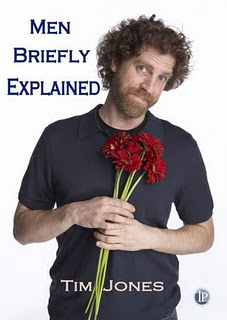
Yes, it's all-poets and all-virtual-book-tours round here at the moment! I "met" Tim Jones when we reviewed his excellent short story collection, Transported, on The Short Review, and we e-bonded over our shared disdain for genre labels. A bit like my previous interviewee, Sarah Salway, he writes in many forms - novels, short stories and poetry, and he's here today to chat about his new poetry collection, the wonderfully-titled Men Briefly Explained.

He kindly agreed to answer my Writing&Place questionnaire (illustrated with gorgeous photos, and some great Lord-Of-The-Rings-related information) and then I tacked on a question I was particularly interested in... and then he has allowed me to reprint one of the poems. I loved the book - hard to choose just one!

TH: Where are you?
TJ: I live in Wellington, New Zealand, in the suburb of Mt Victoria, on the slopes of one of Wellington's many steep hills, Tangi Te Keo aka Mt Victoria. I measure my location by how long it takes to walk to places: 
  •  fifteen minutes to where I work - I have a part-time job in the IT industry, as my writing doesn't quite pay those annoying bills that tend to pile up 
  • ten minutes to the edge of the restaurant district, which transforms into the "drunk teens" district on Friday and Saturday nights 
  • five minutes to the Basin Reserve, Wellington's international cricket ground and one of my favourite places. It was earmarked for a shipping basin until the 1855 earthquake raised it high enough to become a cricket ground instead 
  • maybe 90 seconds to the nearest "Lord of the Rings" filming location 
The floor of the quarry at the top of Ellice St, Mt Victoria, Wellington. In The Fellowship of the Ring, this view is briefly shown when the hobbits look down from Weathertop at the approaching Ringwraiths. Sadly, the cage full of gas pipes was left on the cutting-room floor.

TH: How long have you been there? 

TJ: The short answer is that I've lived in Wellington, and in this house, since 1993. The longer answer is that I was born in Cleethorpes, Lincolnshire in 1959. My family emigrated to New Zealand when I was 2 years old, on an assisted passage - we were what used to be known here as "ten-pound Poms", a term also used in Australia, which proved to be a lucky break for me last year.
The back wall of the quarry above Ellice St, Mt Victoria, Wellington. It may not look like much now, but in The Return of the King, this is where Aragorn, Legolas, and Gimli enter the Paths of the Dead. Don't try to follow them, as you would bump your nose on the rocks.

I grew up in New Zealand's southernmost province, Southland, went to Otago University in Dunedin, and moved to Wellington when I got together with Kay, to whom I've now been married for coming up on 18 years. All these places have left their mark on my poetry, most of all Southland.

What do you write? 

I write more types of work than is good for me: poetry, short stories, and novels. I've had three poetry collections, two short story collections, and one novel published, and I've also co-edited an anthology of New Zealand science fiction poetry, Voyagers: Science Fiction Poetry from New Zealand, with Mark Pirie.

 
Just to make my "brand identity" even more diffuse, I write both speculative fiction (mainly science fiction, but with occasional excursions into fantasy and horror) and literary fiction. Well - literary fiction is a loaded term, so let's say "fiction that isn't speculative fiction". My one published novel is a fantasy novel.

How do you think where you are affects what you write about and how you write? 

I think that the experience of being an immigrant, and the places I've lived since we moved to New Zealand, have had a strong influence on my writing, and that it's affected my fiction and my poetry somewhat differently.

I'm not always aware of this at the time of writing, but looking back at my fiction, I see that a surprising number of my stories are about journeys and voyages, successful or otherwise - it's why I titled my second short story collection Transported - and, especially in my early stories, they are often about figures isolated in a hostile landscape.

Looking from the quarry down Ellice St, Mt Victoria, Wellington, where I live. In the middle distance is the Basin Reserve cricket ground, where I first beheld Arwen Undómiel - well, Liv Tyler anyway. She was watching the cricket with her boyfriend and Théoden (Bernard Hill).


Some of my poems are based on what I observe of other people and the world around me, and some on flights of imagination (intergalactic and otherwise), but much of my poetry is based in personal experience, and a lot of those take place outside somewhere: on beaches, in forests. Although I've written poems about Wellington and Dunedin, a lot of these poems return to my childhood in Southland.
Looking from the top of the Ellice St quarry, where several scenes of Peter Jackson's Lord of the Rings trilogy were filmed, across the Te Aro district of Wellington, with Victoria University and the hill suburb of Kelburn in the distance.

My father used to work as a fisheries inspector, with a beat that took him right across the southern coastline of New Zealand from east to west. There is some wild country down there, and even wilder seas, and those trips with my Dad are particularly treasured memories, as poems like "Men at Sea" show. The first part of that poem is about a trip my Dad took without me, and the second is about the ferry crossing to Rakiura (Stewart Island), off the south coast of Southland, on which I often accompanied him:

Men at sea, I take my father's hand
as we approach the village, houses
hunched against the glowing skies. 

Of course, these poems are also about my relationship with my father.

TH: You write poetry, novels, short stories - how is the process of writing each unique? I'm starting to write poetry and finding that for the first time I can write about myself, which I can never do in fiction. Do you find this?

TJ: I tend to work on one at a time, with occasional recidivism - at the moment, I'm "meant" to be working on short fiction, but my last writing session was mainly spent on writing poetry instead.

Poems and short short stories are different from the others in that I can complete the first draft of a poem or a short-short story in a writing sessions (if all is going well, I can draft several poems in a session). From that perspective, writing a novel is like writing a long short story - both have to be spread over multiple sessions, but the number of sessions for a novel is rather large!
I have written one published and one unpublished novel. At the moment, due to other commitments - my need to bring in enough income to the household, and also environmental campaigns I'm involved in - I don't envisage starting another novel for at least a couple of years, but I am squirrelling ideas for novels away.

Beyond that, when I get an idea or look back at my ideas lists, I usually have a sense of whether this is a "poem idea" or a "short story idea", or proceed accordingly. A couple of times, I have used the same idea in both a poem and a short story, but that's unusual.

Both my fiction and my poetry are a mixture of work based closely on personal experience, work based on observation, and works of imagination (though usually with some observation and personal experience mixed in). I've noticed that it is the poems based on personal experience that tend to work best with a live audience. (Of course, the male character in the poem you've chosen to feature has nothing at all in common with me. Nothing at all!)


We believe you, Tim! Dear reader, you can make up your own mind, here is Tim's poem, Years With a Husband
Years with a Husband

Stone to her water
his edges eroded slowly
leaving the core in place.
He was immovable
from desk, chair,
or opinion,
the slave and exemplar
of routine.

If she let him
he would wear those clothes —
scuffed fawn trousers,
frayed blue shirt —
till eternity,
till kingdom come.
He would vote the same way,
express the same
dislikes:
lawn bowls, modern art, the very thought
of a Pacific holiday.
Their son
she now saw
was growing stony too.
She blamed testosterone
and private schools.

Still, there was this:
that as she stretched and changed
rode the courses of her life
her husband would always be there,
blunt, imperceptive, abrupt:
her rock.

Thank you so much, Tim, for such wonderful answers, pictures and poetry, it's been lovely having you! 

Here is Tim's full bio:

Tim Jones is a poet and author of both science fiction and literary fiction who was awarded the NZSA Janet Frame Memorial Award for Literature in 2010. Tim was born in Cleethorpes, Lincolnshire and his family emigrated to New Zealand when he was 2 years old. Tim now lives in Wellington, New Zealand. 

Tim's third poetry collection, Men Briefly Explained, was published in late 2011. Among his other recent books are fantasy novel Anarya’s Secret (RedBrick, 2007), short story collection Transported (Vintage, 2008), and poetry anthology Voyagers: Science Fiction Poetry from New Zealand (Interactive Press, 2009), co-edited with Mark Pirie. Voyagers won the “Best Collected Work” category in the 2010 Sir Julius Vogel Awards.  

For more, see Tim's blog: http://timjonesbooks.blogspot.com
You can also follow Tim on Twitter: http://twitter.com/timjonesbooks

 And info on how to buy the book - which I highly recommend - 


Details of how to buy Men Briefly Explained in print and various ebook formats are here: http://timjonesbooks.blogspot.co.nz/p/men-briefly-explained.html

For UK readers, Men Briefly Explained is available from Amazon.co.uk as follows:

Kindle ebook: http://www.amazon.co.uk/Men-Briefly-Explained-ebook/dp/B005HRYM32/

Paperback: http://www.amazon.co.uk/Men-Briefly-Explained-Tim-Jones/dp/1921869321/

Large print paperback: http://www.amazon.co.uk/Men-Briefly-Explained-1-Set/dp/1459627903/

 With all these fascinating guests, I'm inspired to go off and write... or at least try and save up to visit New Zealand! You can read the other Writing&Place interviews here.

Sunday, February 26, 2012

Sarah Salway Says You Don't Need Another Self-Help Book

Sarah Salway is a kind of Renaissance Woman: she does so many different things, and does them well - from writing novels and short stories to circus skills, garden history and climbing Mount Kilimanjaro - she's a true inspiration. I feel incredibly lucky not just to be her friend but to have co-tutored an Arvon Foundation short story course with her last year - I have no doubt I learnt as much from her as our students did. And she kept me sane with regular infusions of chocolate, and the odd drop of whisky...

Here's her official bio: 

Sarah Salway is Canterbury Laureate and Royal Literature Fund Fellow at the London School of Economics. You Do Not Need Another Self-Help Book is her first poetry collection, and she is the author of three novels (Something Beginning With, Tell Me Everything and Getting the Picture) and a collection of short stories, Leading the Dance. Her poems have won significant prizes in competitions organised by Poetry London, the Essex Poetry Festival and The New Writer, and have appeared in publications including the Financial Times, The Virago Book of the Joy of Shopping, Mslexia, Pen International and Poetry London. Sarah is the Chair of the Kent & Sussex Poetry Society.

So, this brings me to my joy at hosting Sarah here today to showcase her new book - her first collection of poetry, You Don't Need Another Self Help Book, published by Pindrop Press. Isn't the cover stunning?

Sarah is doing an audio blog tour - the first time I've hosted anything like this, and today she is reading us an excellent poem I heard her read live (at the same reading where I, with great terror, read out my first poem!)  called Love and Stationery. Listen and enjoy...


It's no wonder Philip Gross called her collection
[s]ubtly angled glimpses of love, sex, marriage, which reveal them as they really are: matters of life and death. There's a quiet sizzling underneath the surface of these poems, which can make you smile and wince at the same time.

You may not need another self-help book but you do need this one. Buy it here. You know you want to... You can find out more about Sarah on SarahSalway.net, and listen to her read another poem over at Danuta Kean's website. What fun!

Thursday, December 08, 2011

The Juno Charm visits the blog

Photo: Emilia Krysztofiak
I am very luck in that I have many multi-talented writer friends, one of whom is Nuala Ní Chonchúir - she writes short stories, novels, poetry. Nuala - who is the same age as I am - has published, umm, let's see, three short story collections (Nude, To the World of Men Welcome, The Wind Across the Grass), a novel (You) and now her fourth  poetry collection, The Juno Charm, (the others are Molly's Daughter, Tattoo Tatu, Portrait of the Artist with Red Car). Do I feel inadequate? Is this about me? No, it isn't. It's about Nuala. Here's her full bio:

Born in Dublin in 1970, Nuala Ní Chonchúir lives in Galway county. Her début novel You (New Island, 2010) was called ‘a heart-warmer’ by The Irish Times and ‘a gem’ by The Irish Examiner. Her third short story collection Nude (Salt, 2009)) was shortlisted for the UK’s Edge Hill Prize. Her second short story collection To The World of Men, Welcome has just been re-issued by Arlen House in an expanded paperback edition. The Juno Charm, her third full poetry collection, was launched in November.

I am delighted to be hosting this stop on her blog tour for The Juno Charm, an exquisite, moving, lyrical, visceral - and often very funny - collection of poetry. Since I am a poetry novice attempting to write a few poems, I used this as a chance to pick my talented friend's brain, get some tips. I hope you'll find it interesting too - and it will whet your appetite for the book, which would make an ideal seasonal gift!

Tania: Welcome, Nuala!  Your poems are a wonderful combination of very physical and visceral and soaring flights of language. You use some words I have never heard of (English words!) but didn't want to look them up, I loved the not-knowing. How do you write your poems? Do you search for words that are new to you?


Nuala: I’m now very curious to know what those words were!! [Tania: here are some of them: "jiddering", "drupe", "anchoritic", "lanugo", "vernix", "ocellated"] My poems are written when something flashes into my mind’s eye because of something I have read/seen/heard. Lots of thing interest me but in order to make a poem, a thing has to really grab me and nag at me until I write about it. Like most writers, I love to add to my word-hoard. I use the thesaurus and dictionary daily, when I write, because it’s important to me to always use the right word. I hope that by being a careful writer – meaning one who cares about everything from words to grammar to the overall feel and look of a poem – that I will eventually write something of worth. So, yes, I am always alert to new words and often that new word by itself will spark a poem. ‘Peabiddy’ – Flannery O’Connor’s word for peachicks (baby peacocks) – was a new word to me and it became the apt title to the poem ‘Peabiddy’ which is about my daughter Juno’s birth and my hopes for her. Here’s the text of it:


Peabiddy


The flaps opened and out you popped,
biddy-in-the-box, one wing raised
in a super-heroine’s salute.

We put you there, cock and hen,
rattling feathers and shrieking softly
under canvas in a midland field.

You, our emerald peabiddy,
the actual fact of you musters pride
as we watch amazed at your evolution.

How you stomp on sturdy legs and
perfect your calls: the eee-ow of your tribe,
the vowels and consonants of ours.

Safe passage – we cannot fly with you –
but our nest will always be here and
we can guarantee a soft landing.

T: Just a gorgeous poem, thank you! Many of the poems here deal with extremely personal experiences – sex, miscarriage, birth – is this something you feel that poetry helps you express in a way you can't in other forms – fiction or non-fiction?


N: My poetry tends to be about my life (other than when it involves narratives of other people’s lives, like van Gogh, Kahlo etc.). So it centres a lot on life events like birth, death, illness etc. My fiction tends to me more made-up, that is, not drawn directly from my life, but it will always contain parts of me – my opinions and experiences. I have written about all the same things in fiction (pregnancy loss, sex etc.) but I have transposed those things onto people who are clearly not me. It can be nerve-wracking, in that sense, when a poetry collection comes out because now people know all about the real, raw me, rather than the disguised, fictional me :)


T:Your poems seem to be in conversation with each other, reading the book in one go is a wonderful, complete experience. Was this in any way planned??


N: It wasn’t planned in that the poems were written over a four year period and they reflect what was happening to me and obsessing me over those years and before that. So the writing just grows organically out of whatever is going on, in this case marriage breakdown, divorce, pregnancy loss, remarriage, new love, new baby. So if it’s a conversation, it’s one with myself, trying to make sense of all the ups and downs of the past few years. The planning came later, then, in the ordering of the book – which poem to put where. That’s always a daunting experience but satisfying when the book has a narrative flow. I also ended and began with poems on a high note, to lure the reader in!

T: One final question? What advice would you have for a beginner poet , especially one who writes in other forms (i.e. me!)?


N: Read lots of contemporary poetry - find out what people are writing about and how they are doing it. Go to poetry readings and listen to your peers. Some poets read wonderfully and can be an inspiration. Learn a little about form - you don't have to write in forms but it's good to know a little about them. Maybe get a copy of The Making of a Poem: A Norton Anthology of Poetic Forms, edited by Eavan Boland and Mark Strand. Write about the things that possess and interest you, the things that are dear to your heart. You knit, Tania - I challenge you to write a knitting poem! Thanks so much for having me here today. Next week my virtual tour takes me to Mel Ulm’s The Reading Life blog in the Philippines.

****

Thank you so much, Nuala, for visiting the blog and for sharing something with us about your process and the writing of poetry, what it means to you. (I have the Mark Strand book so i am on the right track!) Nuala blogs at Women Rule Writer, where you can follow the previous and next stops on her tour. You can buy The Juno Charm here. Go on, you know you want to!