So, I'm over at Sarah Salway's blog today, finishing her sentences.... And also in Bridport, running 2 flash fiction workshops at the Open Book festival together with Vanessa Gebbie (workshop one this morning was wonderful, thank you if you came along and flashed with us!) And thirdly, I'm thrilled to have been shortlisted, for the third year running, in PANK's 1001 Awesome Words contest, for my piece, The Tragedy of Tragic Men, to be published in PANK next February. Congratulations to all! The full list is here.
And finally, Ink Tears did a video interview with me, about short stories (of course!) and I was a bit nervous about being videoed, and then about seeing it, but Sara-Mae Tuson did a brilliant job editing it so I thought I'd share...:
Friday, November 25, 2011


Tuesday, November 22, 2011
Sir Paul Nurse and Poetry
(Cross-posted with the Bristol University Science Faculty blog)
There were two great events held here in Bristol last night, one at the University and one at the Bristol Old Vic, and I was hoping against hope that I would find a connection between them to make this blog post flow! And... what do you know? I did. The first was Sir Paul Nurse, president of the Royal Society, Nobel Prize winner, geneticist, president of Rockefeller University New York... all-round very very interesting scientist and excellent talker-about-science! He was giving the Sir Anthony Epstein lecture at the Wills Tower, in the largest, cathedral-like space, which was packed to the rafters... His topic was "Great Ideas in Biology" and he was quick to point out that these weren't THE great ideas in biology but his pick of great ideas... although he felt that most people would agree on 4 out of the 5.
So, what were his great ideas? Well: The Cell, The Gene, Evolution by Natural Selection, Life as Chemistry (and Physics) and the fifth, possibly contentious one, Biology as an Organized System, by which he meant looking at the biological networks and how they are structured, looking at the flow of "information", at the system as an information carrier.
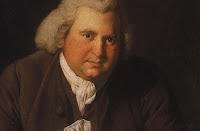 It was all fascinating stuff, some of which I already knew a bit of, but always good to be reminded what a chromosome is, for example... with some great slides and historical perspective! I was then heading to a poetry event, so, I hear you ask, how are the two connected?? Well, it was at Great Idea Number 3, which you would assume centred around one Charles Darwin. But no, in fact Sir Paul wanted to focus on Charles' grandad, Erasmus, who was the first to talk about evolution (Charles later supplied the vast quantities of data to prove it). Not only that, apparently Erasmus - who was a colourful figure, so large that he cut an oval out of his dining table so he might sit rather nearer to his supper, and fathered 14 children - was a poet, at one time "one of the best known poets in England"! And not only that, he wrote much of his scientific reports in blank verse! (See Jenny Uglow on Erasmus Darwin's poetry in The Guardian). The Poetry Foundation gives us his poem, The Botanic Garden, and here is an excerpt:
Stirring stuff! Now the poets I went to see after this lecture, Luke Kennard and Tom Philips, did not deal directly with biology but I feel that Erasmus D would have enjoyed the evening, which moved from a searing critique/love poem about Portishead to a tale of the Murderer being taken for a haircut. I was immensely impressed by the whole event, organised monthly by Word of Mouth - highly recommended if you are in the vicinity!
So, an evening of poetry, biology and biological poetry, what more could I have wanted?
 |
| Photo: Royal Society |
So, what were his great ideas? Well: The Cell, The Gene, Evolution by Natural Selection, Life as Chemistry (and Physics) and the fifth, possibly contentious one, Biology as an Organized System, by which he meant looking at the biological networks and how they are structured, looking at the flow of "information", at the system as an information carrier.

“You taught mysterious Bacon to exploreMetallic veins, and part the dross from ore;With sylvan coal in whirling mills combineThe crystal’d nitre, and the sulphurous mine;Through wiry nets the black diffusion strain,And close an airy ocean in a grain.—Pent in dark chambers of cylindric brass,Slumbers in grim repose the sooty mass;Lit by the brilliant spark, from grain to grainRuns the quick fire along the kindling train;On the pain’d ear-drum bursts the sudden crashStarts the red-flame, and death pursues the flash.—Fear’s feeble hand directs the fiery darts,And strength and courage yield to chemic arts;Guilt with pale brow the mimic thunder owns,And tyrants tremble on their blood-stain’d thrones.
Stirring stuff! Now the poets I went to see after this lecture, Luke Kennard and Tom Philips, did not deal directly with biology but I feel that Erasmus D would have enjoyed the evening, which moved from a searing critique/love poem about Portishead to a tale of the Murderer being taken for a haircut. I was immensely impressed by the whole event, organised monthly by Word of Mouth - highly recommended if you are in the vicinity!
So, an evening of poetry, biology and biological poetry, what more could I have wanted?
Monday, November 14, 2011
New Scientist & Beat the Dust
I've been waiting years to be able to say this: New Scientist have asked me for a science-inspired short story to run in the December 24th issue! I am very very excited... it's a flash story inspired by my time in the biochemistry lab, we will see what New Scientist readers make of it! The title story of my collection, The White Road, which is inspired by an article from New Scientist, was published in New Scientist online just after the book came out and that provoked some interesting discussion....
I'm also delighted to have a flash story, Move Quickly Now, in the current issue of Beat the Dust, along with a playlist inspired by the story, which was a wonderful thing to be asked to do. A taster:
I'm also delighted to have a flash story, Move Quickly Now, in the current issue of Beat the Dust, along with a playlist inspired by the story, which was a wonderful thing to be asked to do. A taster:
She said, “Move quickly now and we'll go together. No, don't look behind. No, don't.” He wondered but followed, only being small and not yet ready for disagreements. Or rather, not yet ready to see if this would be what he decided to be disagreeable about. He was a small boy who chose his battles carefully ....Read the rest here.
Tuesday, November 08, 2011
Happy 4th Birthday to The Short Review!
 |
| www.theshortreview.com |
Happy birthday! This month The Short Review, the journal I founded and edit, turns four years old. In that time, 439 story collections and anthologies have been reviewed, by our forty or so reviewers worldwide, and over 250 authors interviewed... We all do what we do for love of the short story and to spread the word about as many short story collections as possible so readers can get hold of them, demand them from their local bookshops or libraries, buy them as presents.
Four years on, we are so overwhelmed with offers of collections to review that we have had to declare a hiatus in accepting new review copies so that we can catch our breath! A good sign, we think. A very good sign! How could you help us celebrate our birthday? Tell someone about a short story collection you love. Tell ten people. Spread it around!
This month's issue includes an unprecedented seven reviews of multi-author anthologies, which means that we are bringing you short stories by more authors than ever before! From women aloud to the bride stripped bare, the gold boy and the emerald girl, the best british and european fiction, what doesn't kill you if you're with the bears or on the Paris metro in nineteen seventysomething... and... ...
Giveaways - In honour of our birthday - and of the UK's National Short Story Week - we are giving away NINE books: 4 of the books we are reviewing this month - and an extra 5 short story collections! You could win Best British Short Stories 2011, Best European Fiction 2012, the National Short Story Week charity audiobook anthology Women Aloud - and Affirm Press's Long Story Shorts set of six short story collections, which includes Barry Divola's Nineteen Seventysomething. Visit the Competitions page to find out how to win.
Four years on, we are so overwhelmed with offers of collections to review that we have had to declare a hiatus in accepting new review copies so that we can catch our breath! A good sign, we think. A very good sign! How could you help us celebrate our birthday? Tell someone about a short story collection you love. Tell ten people. Spread it around!
This month's issue includes an unprecedented seven reviews of multi-author anthologies, which means that we are bringing you short stories by more authors than ever before! From women aloud to the bride stripped bare, the gold boy and the emerald girl, the best british and european fiction, what doesn't kill you if you're with the bears or on the Paris metro in nineteen seventysomething... and... ...
Giveaways - In honour of our birthday - and of the UK's National Short Story Week - we are giving away NINE books: 4 of the books we are reviewing this month - and an extra 5 short story collections! You could win Best British Short Stories 2011, Best European Fiction 2012, the National Short Story Week charity audiobook anthology Women Aloud - and Affirm Press's Long Story Shorts set of six short story collections, which includes Barry Divola's Nineteen Seventysomething. Visit the Competitions page to find out how to win.
Monday, November 07, 2011
Publication Day for Vanessa Gebbie's The Coward's Tale!

Here's a taste for you:
‘My name is Laddy Merridew. I’m a cry-baby. I’m sorry.’
‘And my name is Ianto Jenkins. I am a coward. And that’s worse.’
The boy Laddy Merridew, sent to live with his grandmother, stumbles off the bus into a small Welsh mining community, where he begins an unlikely friendship with Ianto Passchendaele Jenkins, the town beggar-storyteller.
Ianto is watchman over the legacy of the collapse many years ago of Kindly Light Pit, a disaster whose echoes reverberate down the generations of the town. Through Ianto’s stories Laddy is drawn into both the town’s history and the conundrums of the present.
Why has woodwork teacher Icarus Evans striven most of his life to carve wooden feathers that will float on an updraft? Why is the undertaker Tutt Bevan trying to find a straight path through the town? Why does James Little, the old gas-meter emptier, dig his allotment by moonlight? And why does window cleaner Judah Jones take autumn leaves into a disused chapel?
These and other men of the town, and the women who mothered them, married them and mourned them, are bound together by the echoes of the Kindly Light tragedy and by the mysterious figure of Ianto Jenkins, whose stories of loyalty and betrayal, loss and love, form an unforgettable, spellbinding tapestry. The Coward’s Tale is a powerfully imagined, poetic and haunting novel, spiked with humour. It is a story of kinship and kindness, guilt and atonement, and the ways in which we carve the present out of an unforgiving past.
Visit Vanessa's Coward's Tale blog to find out more... and buy the book on Amazon here.
Friday, November 04, 2011
New stories and upcoming deadlines
Yes, yes, it's been a while, where does the time go! A quick few links to recently-published stories:
Deadline Nov 30th:
The New Writer Poetry and Prose Prizes: for "fact, fiction and poetry" entry online or by post, open to all, prize fund £2500. Categories judged by Jon Pinnock (read my interview with him here), Sally Quilford (who produces a writing calendar) and Bill Greenwell.
Whispered Words: 1000 words max: "welcomes fiction and non-fiction. We accept prose of all kinds: literary, science fiction, children’s, memoir, essay, creative non-fiction. Theme: Whispered Words," entry online, open to all, 1st prize $1000.
Commonwealth Short Story Prize:Awarded for the best piece of unpublished short fiction (2000 – 5000 words). Submissions must be made by the author of the short story. Regional winners receive £1,000 and the overall winner receives £5,000. Entry online only, open to Commononwealth only.
Diamond Light Reading Short Story & Flash Fic Comp: Competition by UK synchotron (don't know what that is? Here's your chance to find out!): "we’re inviting you to submit a story of up to 3,000 words inspired by Diamond – the facility, the science and the people. There’s also a Flash Fiction prize for stories under 300 words. Stories can be in any genre and there is no minimum word limit. The top three writers will receive a cash prize, and these, along with those highly commended by the judges, will be published in an anthology of short stories." £500 first prize. Entry online only, open to all.
I'll stop there for the moment... got to go do some writing. Good luck to all!
I've just had a story accepted by Beat the Dust, coming in November, and another by Metazen for December 8th Lovely, all lovely. To inspire - me and you! - here are some upcoming deadlines for story and poetry submissions:
- Like Owls is published in SPECS, an annual print journal which is full of the weird and wonderful (my kind of thing). You can't read the prose poem online but you can watch a video of me reading it and read a short paragraph about how I came to write it.
- All Activity is Silent is published in Issue 15 of kill author, an online journal also filled with weird and wonderful. (You can also hear me reading it on the site.)
- And third for the weird and wonderful, The Watch My Father Wanted, in Metazen. Text only! These kinds of publications make me so happy, that there are others on my warped wavelength. They are full of gems, do check them out.
Deadline Nov 30th:
The New Writer Poetry and Prose Prizes: for "fact, fiction and poetry" entry online or by post, open to all, prize fund £2500. Categories judged by Jon Pinnock (read my interview with him here), Sally Quilford (who produces a writing calendar) and Bill Greenwell.
Whispered Words: 1000 words max: "welcomes fiction and non-fiction. We accept prose of all kinds: literary, science fiction, children’s, memoir, essay, creative non-fiction. Theme: Whispered Words," entry online, open to all, 1st prize $1000.
Commonwealth Short Story Prize:Awarded for the best piece of unpublished short fiction (2000 – 5000 words). Submissions must be made by the author of the short story. Regional winners receive £1,000 and the overall winner receives £5,000. Entry online only, open to Commononwealth only.
Diamond Light Reading Short Story & Flash Fic Comp: Competition by UK synchotron (don't know what that is? Here's your chance to find out!): "we’re inviting you to submit a story of up to 3,000 words inspired by Diamond – the facility, the science and the people. There’s also a Flash Fiction prize for stories under 300 words. Stories can be in any genre and there is no minimum word limit. The top three writers will receive a cash prize, and these, along with those highly commended by the judges, will be published in an anthology of short stories." £500 first prize. Entry online only, open to all.
I'll stop there for the moment... got to go do some writing. Good luck to all!
Thursday, October 20, 2011
Two great events and more coming...
My blogging is suffering, sorry about that, but here's a quick post about what I've been up to. On Tuesday I was involved in 2 brilliant events -the first was part of Bristol University's new Inside Arts festival, a session about reading groups, some of whom had read my flash story Plaits - a very enthusiastic audience chatted with me and Tom Sperlinger about reading, about writing, about flash fiction, it was just wonderful, I really enjoyed it. And I gained some insights about my own story, which is always such a boost. (And it was lovely to finally meet Debs Rickard!)

I then rushed off to Bristol Foyles for the launch of the 2012 Bristol Short Story Prize, which is something very close to my heart, not just because I've been a judge for the past two years, but in great part because the prize's organiser, Joe Melia, is truly a tireless champion of short stories and of writers. I am so honoured to be involved (not as a judge this year...).
The launch kicked it all off so well - with readings by last year's winner, Emily Bullock (whose winning story, hearing it read by her, stirred me all over again), Bristol-based writer Alan Toyne (unforgettable descriptions of a sweat lodge) and the fabulous Jonathan Pinnock (read my chat with him here), who read two flashes, one of which was new to me, Canine Mathematics - and anything to do with maths always warms my heart!
I wound up the first part of the festivities by reading four flash stories - including one I'd never read out before that was picked by the audience: I asked them to shout out a letter of the alphabet and I found a story whose title began with "W". (I read We Watched Him On Our Screens which you can read here.)
The Bristol Short Story Prize is now well and truly open - get your entries in!
Coming up: It's a busy week for me, I have three more events, all part of the new Unputdownable Bristol Festival of Literature: Friday at 6pm at Henleaze Library we'll be finishing off the citywide short story... Saturday 4-5pm at Hooper House Cafe on Stokes Croft I'll be reading together with the excellent Pauline Masurel, Amy C Mason and Jules Hardy... Saturday 7.30-9.30pm at Hamilton House, Stokes Croft, the citywide short story will be revealed... and I'll be revealing how I avoid writer's block!
I then rushed off to Bristol Foyles for the launch of the 2012 Bristol Short Story Prize, which is something very close to my heart, not just because I've been a judge for the past two years, but in great part because the prize's organiser, Joe Melia, is truly a tireless champion of short stories and of writers. I am so honoured to be involved (not as a judge this year...).
The launch kicked it all off so well - with readings by last year's winner, Emily Bullock (whose winning story, hearing it read by her, stirred me all over again), Bristol-based writer Alan Toyne (unforgettable descriptions of a sweat lodge) and the fabulous Jonathan Pinnock (read my chat with him here), who read two flashes, one of which was new to me, Canine Mathematics - and anything to do with maths always warms my heart!
I wound up the first part of the festivities by reading four flash stories - including one I'd never read out before that was picked by the audience: I asked them to shout out a letter of the alphabet and I found a story whose title began with "W". (I read We Watched Him On Our Screens which you can read here.)
The Bristol Short Story Prize is now well and truly open - get your entries in!
Coming up: It's a busy week for me, I have three more events, all part of the new Unputdownable Bristol Festival of Literature: Friday at 6pm at Henleaze Library we'll be finishing off the citywide short story... Saturday 4-5pm at Hooper House Cafe on Stokes Croft I'll be reading together with the excellent Pauline Masurel, Amy C Mason and Jules Hardy... Saturday 7.30-9.30pm at Hamilton House, Stokes Croft, the citywide short story will be revealed... and I'll be revealing how I avoid writer's block!
Sunday, October 09, 2011
Interviewed by Tim Love aka LitRefs
Just a quick post to direct you to Tim Love's excellent blog, LitRefs, a fantastic resource for all things literary. I've "known" Tim online for several years and he asked if he could ask me some questions - about our shared loved for fiction and science, about short stories, poetry, etc... Here's a taster:
What came first - Science or Fiction?You can read the rest of the interview here. Thanks, Tim!
Definitely fiction! I started reading at a very early age, apparently, according to my mother (yes, she does say I was a prodigy, she is my mother) and stories were a big part of my childhood. Science came later, I have vague memories of reading some children's book about Famous Scientists but have no idea when that was. It was at school that I fell for maths (gosh now that sounds odd). I just loved solving equations, loved the right-or-wrongness, the lack of greyness, although now I understand far better that science and the scientific endeavour are full of grey areas.
Monday, October 03, 2011
White Rabbit Live Lit Tea Party

I was delighted to have one of my short short stories, Underground (previously published in PANK a few years ago - scroll down) chosen for their "Underground" themed night on Friday night, where it would be read by an actor. And I was invited to come along (they really like the writers to be there) and listen.
Well, I've been to live lit events before, but never one where the tables had proper cake stands filled with tiny homemade cakes, tea cups brimmed with sweeties (yes, gentle reader, I ate them all), and where the chip butties flowed freely! Not only were the readings - by organizers Gareth and Bernadette, actors and writers, and the guest reader, Fiona - excellent, but the atmosphere was wonderful, they constantly made sure that I was okay, since I'd come alone, and supplied with chip butties. After all the readings, we played pass-the-parcel! (Non-Brits, see here for explanation) with prizes! I felt well and truly back in the 1970s, in the best way - especially given the Wombles-themed story that came with soundtrack. I went home with a specially-printed copy of my story in a beautifully-made folder and a White Rabbit memory stick I bought with Gareth and Bernadette reading about 3 hours of stories.
A cracking evening, a delight for writers, a joy for anyone who loves stories and loves being read to - submit for their next themed nights, see The White Rabbit for more. I can't recommend this highly enough, thank you Gareth and Bernadette!
Thursday, September 29, 2011
Aliens aliens aliens... and Mrs Darcy

I was wrong.
I giggled. I chortled. I couldn't stop reading. Not only is this an utterly wonderful story and oddly fitting with Jane Austen's characters (Lady Catherine de Bourgh, an alien? Of course, silly me for not knowing that). I can't help but feel that Jane would be quite pleased.

I already knew I enjoyed Jon's short stories, having (anonymously) highly commended his story, Advice re Elephants, when I judged last year's Sean O'Faolain short story competition and was part of the judging team who shortlisted his story rZr and Napoleon for the 2010 Bristol Short Story Prize. It's clear from these that he has a rather wicked sense of humour and a sly wit. So, I have asked him a few tricky questions, on your behalf:
Tania: Welcome, Jon. I recently met a very interesting biologist, Rachel Rodman, who also writes, and she has come up with a whole theory about literary mash-ups, of which I believe your book is one. Her article is published in LabLit. She calls you and your kind (!) "literary geneticists" and, using Pride and Prejudice and Zombies as her example, says:
Pride and Prejudice and Zombies is in this sense a genetically modified organism, derived from the ancestral Pride and Prejudice by the introduction of new (genetic) material taken from the unrelated "monster" genre. A small-scale comparison of the two texts supports this idea: all Grahame-Smith's modifications have parallels with genomic modifications performed (or harnessed) by laboratory scientists. Here, I examine six classes (Insertions, Duplications, Insertions with Duplication, Replacements, Over-expression, and Gain-of Function Mutations) of these modifications, and draw parallels with biological examples.Her thesis is lengthy and erudite! So we will skip to her final thoughts:
These six sections consider only a few of the classes of Grahame-Smith's modifications. Pride and Prejudice and Zombies is also marked by DNA inversions (in the form of transposed words and phrases), silent mutations (in the form of synonym replacements), and missense mutations (in the form of deliberately misspelled words), and so on. The molecular techniques used by Grahame-Smith have also been applied to other works, enabling the production of a range of genetically modified texts: Android Karenina, The Meowmorphosis, Jane Slayre, and others. These modified texts possess new phenotypes. Some are merely new twists of humor, curious for their own sake, like a mammal engineered to possess fluorescent skin. Others, more utilitarian, render the text appealing to new audiences, like a plant engineered for cold-resistance, enabling it to grow at new latitudes. The success of these variants – some commercial, some aesthetic – sets the stage for a new generation of literary geneticists, whose experiments will force the field in new directions. This new dynamic, converting the writing desk to a laboratory and the classic text to a model organism, may in addition pose its own ethical questions. We exist in a new era, exciting and disturbing, in which neither text nor genome is immutable, and in which humans, armed with new technologies, can force their evolution. [My emphasis]Any reactions to this?
Jon: Right, here goes...*deep breath* Firstly, a confession: I've never actually read Pride and Prejudice and Zombies. This was partly because I was miffed about its unexpected appearance at a time when I was struggling to find a way into my own book and also because I didn't want to be accidentally influenced by it. I did feel obliged to refer to it in my book, because it would have felt odd not to acknowledge its presence, and it did provide an opportunity for going off at an interesting tangent with Jane Austen herself featuring as a disenchanted writer of cheap zombie novels. And I swear I never knew there were ninjas in P&P&Z until I read that article, although one of Jane Austen's supposed novels that I refer to also has ninjas in it!
However, having read the
article, I am actually quite tempted to buy the book now because it
makes it sound like an avant garde literary exercise worthy of Georges
Perec or Tom Phillips. I like to think that what I'm doing is slightly
different, because what I've written is an entirely logical sequel to
the original book, rather than a mash-up of it. I originally described it
as the bastard offspring following a drunken one-night stand between
Pride and Prejudice and the X Files, which I guess in genetic terms
means that it's less the result of gene splicing than the outcome of
some dubious experimental breeding programme.
T: Dubious experimental breeding, love it! Entirely logical sequel? Ha! Okay,
we'll keep this short: I couldn't stop laughing when I read the book,
did you have that problem while you were writing it?
J: You're far too kind! Well, I know you're not supposed to laugh at your
own jokes, but I did let out the occasional guffaw, usually when
something completely unplanned emerged. Or at one of Lord Byron's double
entendres. I have a weakness for those, I'm afraid.
T: And: I know you wrote it Dickens-like (or soap-operatically) in instalments, do you think your process/the end product would have been different if you'd attempted to do it all in one go, whatever that might mean?
J: Good question. It's a bit hypothetical, because I can't really think of
any other way to write. I didn't have any sort of plan at all when I
started writing the serialisation - although a plot of sorts did present
itself once I'd got a chapter or two in. The thought of having a pin
board with colour-coded timelines on it - well, it's just too weird to
contemplate. Some of my favourite bits of Mrs Darcy... came about because I
found myself at midnight on the day before the next episode was due to
go live with nothing to publish. However, as a way of working it can be
more than a little stressful.
T: Well, stress keeps us going, doesn't it? I say, Whatever works!

Thanks so much for stopping by, Jon. To whet your appetite, here's a pic I took of the book in the horror section of Waterstone's in Cork... Find out more, including how to buy it, excerpts and other crazy stuff, at Mrs Darcy And the Aliens and more about Jon and his other writings at jonathanpinnock.com.
Wednesday, September 28, 2011
Less hopeless, thank you
I feel better after writing yesterday's post. It wasn't journalism, it wasn't a post about how to get published/get an agent. It wasn't an objective post at all - it was just about how I was feeling. Several people in the comments thanked me for my honesty and really it was the first time I'd written a really honest blog post for a long time. It has become harder and harder to do that since people are actually reading my blog! (I'm very grateful, don't get me wrong, just a little shy.)
I try to stay upbeat here, but it's hard to be relentlessly positive when that's not what's actually going on. I think perhaps part of the "silence" of the blog title was my own silence about this and now that I've vented, got it out, I feel better. I did worry a bit that I was shooting myself in the foot, if any agents ever read the post that would be it for me. But sometimes you've just got to get it out.
And something certainly did get "out"! Yesterday, a few hours after the post went up and apparently completely unconnected to it, I heard from the assistant of the first agent I wrote to, 8 weeks ago, apologizing for the delay! I think she may have been overwhelmed by the gratitude of my response! So, what can we learn from this? That this agent, at least, is not in the "no response means no" business, and for this I am thankful.No guarantees, but the assistant liked my writing enough to pass them on to the agent.
Okay, that takes us back to some positive news. Here, on this very blog, tomorrow, I am hosting the almost-final leg in Jonathan Pinnock's mammoth "Mrs Darcy versus the Aliens" blog tour! Intrigued? Pop back tomorrow. And huge congratulations to my writer friend M on her book deal (more about that when I am allowed)! Good news all round!
I try to stay upbeat here, but it's hard to be relentlessly positive when that's not what's actually going on. I think perhaps part of the "silence" of the blog title was my own silence about this and now that I've vented, got it out, I feel better. I did worry a bit that I was shooting myself in the foot, if any agents ever read the post that would be it for me. But sometimes you've just got to get it out.
And something certainly did get "out"! Yesterday, a few hours after the post went up and apparently completely unconnected to it, I heard from the assistant of the first agent I wrote to, 8 weeks ago, apologizing for the delay! I think she may have been overwhelmed by the gratitude of my response! So, what can we learn from this? That this agent, at least, is not in the "no response means no" business, and for this I am thankful.No guarantees, but the assistant liked my writing enough to pass them on to the agent.
Okay, that takes us back to some positive news. Here, on this very blog, tomorrow, I am hosting the almost-final leg in Jonathan Pinnock's mammoth "Mrs Darcy versus the Aliens" blog tour! Intrigued? Pop back tomorrow. And huge congratulations to my writer friend M on her book deal (more about that when I am allowed)! Good news all round!
Tuesday, September 27, 2011
The hopeless hopeful silence
I'm recovering from a packed ten days, first at the Cork International Short Story Festival and then this past weekend at the Small Wonder short story festival. Both were wonderful, but the reason I decided to treat myself and go to both is rather less wonderful. I've been feeling depressed about the short story. Not about the short story itself, good heavens no! How could I, when reading short stories brings such joy into my life and writing them might even have saved my life.
No, I've been depressed about the "business" of short stories, and more specifically short story collections. It's only so much we short story writers and lovers can take of being told the same thing again and again and again... No-one reads short stories...No-one buys short story collections...No-one wants your work.. Oh, I don't like short stories... Then came the BBC Radio 4 Afternoon Reading cuts, which I found out about on my birthday. Charming. Sign the protest petition here. At least the comments by signatories are really heartening.
Then a few days ago someone in the audience at Small Wonder even asked one of the speakers why they write short stories since short story writers are "in the graveyard of writing", or something to that effect. You can imagine how I was feeling hearing that. We're in the graveyard of writing? We're dead? Who's dead? We write for the dead?
My first reaction is, No we're bloody well not, there are thousands of people worldwide who love reading short stories. Maybe even more than that. It was heartening in Cork to meet a wonderful Canadian writer, Deborah Willis, whose first collection was bought by Penguin Canada without an agent and was nominated for the Governer General's Award - and for her to tell me she is under no pressure to write a novel. Of course, in Canada you just say the words "Alice Munro" like a magic password if someone dares to suggest that you "graduate" from the little short story to the mightly novel.
Now, my rant here is not against novels - that would be utterly ridiculous. Some of my best friends are writing novels :) No, my rant here is that writers aren't being allowed to write whatever they want - and, more than that, what they are good at.
Second rant, and this relates to the title of this post and is more personal. I've been thinking it's about time I looked for an agent. I had a few meetings in 2009 when my book was commended for the Orange Award for New Writers, and everyone was very kind but I didn't have anything for them to sell. That made sense. Well, now I am 3/4 of the way through a new collection, biology-inspired fictions, funded by an Arts Council England grant, and so I thought this might be a good time.
I want to state categorically here that I fully expected the "I'm so sorry but we just can't sell short story collections at all right now". I figured there was a 0.0001% chance an agent would buck that trend. What I didn't bargain for was this: silence. Total and utter silence, from three agents. I wrote what I thought was a well-constructed query email, and I had a personal recommendation to each agent through writer friends and another agent. But... I was also completely honest about only wanting to write short stories.
No response. Nothing. And it's been 6 weeks or more...
And then last week I read about the new "no response means no" policy apparently being adopted by a number of literary agents. This equates to: if we don't write back, we don't want you. I am very thankful that I am not alone in find this quite shocking. You don't have a minute to even paste in a form reply saying "no"? Apparently, one agent said she employs the "no response" tactic because she doesn't like dealing with the "negativity" of having to reject people. Oh my.
I'd like to put my Short Review editor's hat on here. We receive a lot of queries asking if we might review a newly published short story collection, many more than we can, in fact, review (which is good news for short story collections). I have a form reply in which the first thing I do is congratulate the author or publisher - because, especially in this climate, I believe every short story collection published is a cause for celebration! I then explain how I will try and find a reviewer but it might not happen. It makes me sad, the number of collections we won't be able to review since we "only" review 10 a month. But I would never dream of ignoring an email. Never.
As editor last year of Southword, I had to pick 6 short stories for the issue. This meant rejecting hundreds of stories - a number of which were submitted by friends of mine. How did I feel? Sick. Because I knew exactly how it would feel to get that email, however kindly I worded it.
But to leave someone hanging, not knowing if the non-response is a sign that there is hope or not, is, frankly, cruel. I think it is deeply uncivilized. And if that agent thinks she is avoiding negative karma by not sending an actual rejection, she is mistaken. She should congratulate and applaud every single person who gets up the guts to write to her. Don't we all know how hard it is to move from "I'm trying to write" to "I am a writer", to take that leap into sending out your work to a publication, to then even contemplate the next step, the possibility of an agent taking you on?
Thankfully, there are a number of agents who have reacted to this "no reply means no" and said that they simply don't agree with this. I think we should vote with our feet - if an agent has a "no reply means no" policy, perhaps we should send them silence first, before they can send it back. And let's give ourselves a round of applause, for just putting ourselves out there.
It's not easy. I am trying to stop worrying so much about the "business" side of all this and get back into the writing. Thank goodness for all the amazing small presses out there who are publishing the books - not just story collections - that are the sorts of things that no-one thinks will sell. They are to be applauded too. As a very wise friend of mine said, mainstream publishing is a bit like Marks & Spencers - they aren't going to agree to sell a limited edition of your hand-painted belts unless it's a very special occasion. And if what you're creating doesn't even really look like a belt... well then.
In the mean time, I'm getting down to some writing. I'm going to stop caring if I'm making the right kind of belts. I'm going to let it all hang out.
ADDENDUM
I forgot to mention that this also comes after hearing many many stories from fellow writers of non-responses, not just to initial queries like mine, which didn't include an MS, but after agents have requested an MS to be rushed overnight to them, they are so excited about it! And then.... silence. Is this a good way to do business?
ADDENDUM 2
I am being told that 12 weeks is about standard for a response time, so it seems I was jumping the gun here. But this isn't just about me, this is about a principle which I do hope isn't becoming the norm. I've just had a response from an agent's assistant apologizing for the delay - it seems it's a complete coincidence that it came today, and I have thanked her profusely for just ending the silence. I don't mind waiting and waiting... not at all, I understand how large the slush piles are. I just needed to know that I hadn't sent my queries into a void! An autoreply, as mentioned in the comments here, would have helped immensely.
No, I've been depressed about the "business" of short stories, and more specifically short story collections. It's only so much we short story writers and lovers can take of being told the same thing again and again and again... No-one reads short stories...No-one buys short story collections...No-one wants your work.. Oh, I don't like short stories... Then came the BBC Radio 4 Afternoon Reading cuts, which I found out about on my birthday. Charming. Sign the protest petition here. At least the comments by signatories are really heartening.
Then a few days ago someone in the audience at Small Wonder even asked one of the speakers why they write short stories since short story writers are "in the graveyard of writing", or something to that effect. You can imagine how I was feeling hearing that. We're in the graveyard of writing? We're dead? Who's dead? We write for the dead?
My first reaction is, No we're bloody well not, there are thousands of people worldwide who love reading short stories. Maybe even more than that. It was heartening in Cork to meet a wonderful Canadian writer, Deborah Willis, whose first collection was bought by Penguin Canada without an agent and was nominated for the Governer General's Award - and for her to tell me she is under no pressure to write a novel. Of course, in Canada you just say the words "Alice Munro" like a magic password if someone dares to suggest that you "graduate" from the little short story to the mightly novel.
Now, my rant here is not against novels - that would be utterly ridiculous. Some of my best friends are writing novels :) No, my rant here is that writers aren't being allowed to write whatever they want - and, more than that, what they are good at.
Second rant, and this relates to the title of this post and is more personal. I've been thinking it's about time I looked for an agent. I had a few meetings in 2009 when my book was commended for the Orange Award for New Writers, and everyone was very kind but I didn't have anything for them to sell. That made sense. Well, now I am 3/4 of the way through a new collection, biology-inspired fictions, funded by an Arts Council England grant, and so I thought this might be a good time.
I want to state categorically here that I fully expected the "I'm so sorry but we just can't sell short story collections at all right now". I figured there was a 0.0001% chance an agent would buck that trend. What I didn't bargain for was this: silence. Total and utter silence, from three agents. I wrote what I thought was a well-constructed query email, and I had a personal recommendation to each agent through writer friends and another agent. But... I was also completely honest about only wanting to write short stories.
No response. Nothing. And it's been 6 weeks or more...
And then last week I read about the new "no response means no" policy apparently being adopted by a number of literary agents. This equates to: if we don't write back, we don't want you. I am very thankful that I am not alone in find this quite shocking. You don't have a minute to even paste in a form reply saying "no"? Apparently, one agent said she employs the "no response" tactic because she doesn't like dealing with the "negativity" of having to reject people. Oh my.
I'd like to put my Short Review editor's hat on here. We receive a lot of queries asking if we might review a newly published short story collection, many more than we can, in fact, review (which is good news for short story collections). I have a form reply in which the first thing I do is congratulate the author or publisher - because, especially in this climate, I believe every short story collection published is a cause for celebration! I then explain how I will try and find a reviewer but it might not happen. It makes me sad, the number of collections we won't be able to review since we "only" review 10 a month. But I would never dream of ignoring an email. Never.
As editor last year of Southword, I had to pick 6 short stories for the issue. This meant rejecting hundreds of stories - a number of which were submitted by friends of mine. How did I feel? Sick. Because I knew exactly how it would feel to get that email, however kindly I worded it.
But to leave someone hanging, not knowing if the non-response is a sign that there is hope or not, is, frankly, cruel. I think it is deeply uncivilized. And if that agent thinks she is avoiding negative karma by not sending an actual rejection, she is mistaken. She should congratulate and applaud every single person who gets up the guts to write to her. Don't we all know how hard it is to move from "I'm trying to write" to "I am a writer", to take that leap into sending out your work to a publication, to then even contemplate the next step, the possibility of an agent taking you on?
Thankfully, there are a number of agents who have reacted to this "no reply means no" and said that they simply don't agree with this. I think we should vote with our feet - if an agent has a "no reply means no" policy, perhaps we should send them silence first, before they can send it back. And let's give ourselves a round of applause, for just putting ourselves out there.
It's not easy. I am trying to stop worrying so much about the "business" side of all this and get back into the writing. Thank goodness for all the amazing small presses out there who are publishing the books - not just story collections - that are the sorts of things that no-one thinks will sell. They are to be applauded too. As a very wise friend of mine said, mainstream publishing is a bit like Marks & Spencers - they aren't going to agree to sell a limited edition of your hand-painted belts unless it's a very special occasion. And if what you're creating doesn't even really look like a belt... well then.
In the mean time, I'm getting down to some writing. I'm going to stop caring if I'm making the right kind of belts. I'm going to let it all hang out.
ADDENDUM
I forgot to mention that this also comes after hearing many many stories from fellow writers of non-responses, not just to initial queries like mine, which didn't include an MS, but after agents have requested an MS to be rushed overnight to them, they are so excited about it! And then.... silence. Is this a good way to do business?
ADDENDUM 2
I am being told that 12 weeks is about standard for a response time, so it seems I was jumping the gun here. But this isn't just about me, this is about a principle which I do hope isn't becoming the norm. I've just had a response from an agent's assistant apologizing for the delay - it seems it's a complete coincidence that it came today, and I have thanked her profusely for just ending the silence. I don't mind waiting and waiting... not at all, I understand how large the slush piles are. I just needed to know that I hadn't sent my queries into a void! An autoreply, as mentioned in the comments here, would have helped immensely.
Tuesday, September 20, 2011
Newly published + Kindle Special Offer
While I recover from and gather my thoughts - and my photographs - about the Cork Short Story Festival, here are a few new and rather nice things. It's a bit of a bumper month for me in terms of publication (a bumper year, actually - this makes it 14 pieces published since January):
Lastly, Salt are doing a very special Kindle promotion right now which means you can purchase my collection for the Kindle for 86p or 99 cents! You can also buy books buy the Best British Short Stories, edited by Nicholas Royle, and books by the wonderful Wena Poon and David Gaffney, Luke Kennard and others... See the Salt blog for the full list. I don't have a Kindle but if I did, I would be overloading that Amazon whispernet thingy with all my downloads....
Okay, back to sorting out Cork festival photographs. In the meantime, read the blogs by Women Rule Writer, Orfhlaith Foyle, Ethel Rohan at Dark Sky Magazine and the official festival blog.
I have a poem, Moss, in the new issue of Alba, the Journal of Short Poetry.I also have a few more stories and prose poems forthcoming in the next few weeks, in SPECS, kill author and Electric Velocipede. I'm immensely grateful too all these wonderful publications and encourage you to support them not just by reading what they publish but by also doing them the honour of sending them your work.
My prose poem, Timeless, written in memory of our lovely Cleo is published in .Cent magazine (Page 13), a stunning fashion mag which also has prose.
My short short story, Waving on the Moon, is in the latest issue of A capella Zoo, a fantastic print journal of magical realist and speculative fiction and poetry, it's well worth grabbing a copy!
Lastly, Salt are doing a very special Kindle promotion right now which means you can purchase my collection for the Kindle for 86p or 99 cents! You can also buy books buy the Best British Short Stories, edited by Nicholas Royle, and books by the wonderful Wena Poon and David Gaffney, Luke Kennard and others... See the Salt blog for the full list. I don't have a Kindle but if I did, I would be overloading that Amazon whispernet thingy with all my downloads....
Okay, back to sorting out Cork festival photographs. In the meantime, read the blogs by Women Rule Writer, Orfhlaith Foyle, Ethel Rohan at Dark Sky Magazine and the official festival blog.
Friday, September 16, 2011
The Watch My Father wanted

Thursday, September 15, 2011
Cork International Short Story Festival Day 1
So, I'm here in Cork, again, at the Cork International Short Story festival (formerly the Frank O'Connor International Short story Festival) and I am just so happy to be here! To be amongst like-minded short story folk, listening to amazing writers read their stories and talk about stories - til Sunday night - is just, for me, sublime.
The festival kicked off with the wondrous Helen Dunmore, here she is. (I forgot to take my proper camera, tomorrow's pics will be better, I promise!)
 She read a story from her collection Ice Cream, called The Polish Teacher's Tie, which I had only read a few weeks ago. It was lovely hearing her read it. Just lovely. And she talked about what it was like to win prizes... and not to win prizes! We had a very nice chat afterwards - she is dashing back to Bristol tomorrow, which is a shame, but - SPOILER ALERT - she is going to be the guest on the Arvon Foundation short story course I am co-tutoring with Adam Marek in Nov 2012, so I just wanted to introduce myself, say hi. I tried not to gush too much! She and I expressed our dismay at the BBC Afternoon Reading cuts (check out Wrath of God's latest blog post for more on that).
I was thrilled to finally meet my online friend and fabulous writer Ethel Rohan, who is reading at the festival on Friday - originally Irish, she now lives in San Francisco. We have published each other - I chose one of her stories when I edited Southword and she asked me to contribute when she was guest editor at Necessary Fiction, so it is just great to finally meet her and once again have that wonderful experience when an online acquaintance is just as great - if not more so - in person!
And then... the final readings of the evening, by Orfhlaith Foyle and Peter Murphy, Irish writers who knocked me - and the rest of the audience, I think - sideways with their astonishing prose. I felt flattened, in the best way, by their dark and powerful stories. Just astonishing. Seek them out! (You can read an interview with Orfhlaith on Nuala Ní Chonchúir''s blog here.)
Then we, as tradition dictates, retired to the local tapas bar to unwind. I am still wound though! Too much stimulation. Okay, must muster my strength for tomorrow. Check out the Cork International Short Story festival website to see what's in store...
The festival kicked off with the wondrous Helen Dunmore, here she is. (I forgot to take my proper camera, tomorrow's pics will be better, I promise!)

I was thrilled to finally meet my online friend and fabulous writer Ethel Rohan, who is reading at the festival on Friday - originally Irish, she now lives in San Francisco. We have published each other - I chose one of her stories when I edited Southword and she asked me to contribute when she was guest editor at Necessary Fiction, so it is just great to finally meet her and once again have that wonderful experience when an online acquaintance is just as great - if not more so - in person!
And then... the final readings of the evening, by Orfhlaith Foyle and Peter Murphy, Irish writers who knocked me - and the rest of the audience, I think - sideways with their astonishing prose. I felt flattened, in the best way, by their dark and powerful stories. Just astonishing. Seek them out! (You can read an interview with Orfhlaith on Nuala Ní Chonchúir''s blog here.)
Then we, as tradition dictates, retired to the local tapas bar to unwind. I am still wound though! Too much stimulation. Okay, must muster my strength for tomorrow. Check out the Cork International Short Story festival website to see what's in store...
Tuesday, September 13, 2011
Congratulations to the Sean O'Faolain Prize Shortlistees
MunsterLit has just announced the shortlist for the Sean O'Faolain short story competition - congratulations to all! Winner announced on Sunday at the Cork International Short Story Festival:
Guy Barriscale (Donegal, Ireland)--'Jamesy'Jeremy Castle (Tipperary, Ireland)--'The Smallest Window in the World'P.G. O'Connor (Limerick, Ireland)--'The Haggard'David O'Doherty (Cork, Ireland)--'Post Office'Laura Rock (Ontario, Canada)--'Woman Cubed'Martha Williams (Cornwall, UK)--'Wet Stones'
Monday, September 12, 2011
Brand new short story competition!
 Thanks to Women Rule Writer for this one: The Moth-Altun Short Story Prize is a new prize for a story of up to 2500 words. Entries by post or online. There will be one prize of €1,000. Entry fee: €8 Judge: Christine Dwyer Hickey Closing date: 31 March 2012 More details on The Moth's website.
Tuesday, September 06, 2011
Giveaways and great events
I thought I'd give a plug to a few great things:
Rosa Mira books, the wonderful New Zealand publisher whose Slight Peculiar Love Stories e-anthology includes four of my flash stories, is having an e-book giveaway. Visit their Facebook page for details. It's worth it!
If you're anywhere near Stroud - or could be - check out Stroud Short Stories, a live lit event held every few months. Submissions for the October event close September 18th.
And if you are anywhere near Brighton - or could be - check out this exciting-sounding FlashLit Fiction event from StoryStudio: "Flash fiction night with a digital bent launches at this year's Brighton Digital Festival": Flash
Lit Fiction takes place on Sunday 11 September at Sticky Mike’s Frog
Bar on Middle Street, Brighton, from 7-10pm. Advanced tickets are now on
sale £6 from Eventbrite website http://bit.ly/nlOpkW or more on the door.
Much to enjoy!
Thursday, September 01, 2011
Guest editor at National Short Story Week

Friday, August 19, 2011
My guest blog post: Noticing
Every Day Fiction's Flash Fiction Chronicles blog asked me for a guest blog post quite a while ago and I just couldn't think of anything to write about. And then a few weeks ago I had a strange experience and it struck me that this was the thing for FFC... My guest blog post on Noticing is now up on the FFC blog. A taster:
A few years ago, I was told off by a fellow short story writer for not carrying a notebook around with me. I had foolishly assumed that when an idea came, if it was “good enough” I would remember it. I was already then at an age where memory is not as sharp as it was. And there is so much competing for our attention that ideas don’t stand much of a chance of being retained.Read the full post here>>
Subscribe to:
Posts (Atom)